Success is getting what you want; happiness is liking what you get

Saturday, 15 June 2013

Black Beauty comes to Levin

An eye catching steel and fibre glass sculpture of a magnificent horse has recently appeared at the southern end of Levin.  This sculpture stood proudly in front of the Awapuni Hotel, Palmerston North,  since the 1990s.  But the pub was being demolished and Black Beauty was to be sent away to the scrap metal yard.  Local stonemason Richie Cornell of Designer Stones was having none of that.  A regular at the pub in his younger days, he had always admired the horse.  Richie decided he must save Black Beauty and give him a new home.

After agreeing on a price, the next step was working out how to transport the large sculpture which weighed well over a tonne.  A friend who owned a crane offered his help, and a special harness was procured to do the lifting without causing any damage.  After decades of exposure to the weather and little maintenance, the horse needed a fair bit of painstaking restoration.  All worth the effort, Richie said, who created the cradle on which to display the horse.  With his head down, and his hooves and tail flying in the wind, Black Beauty is now on display in the front paddock of Richie’s home for all to passers by to enjoy.

P6148043 Black Beauty rides again

This magnificent piece was the work of J. A. Fligel, originally from Scotland but who now lives in Toronto.  During 1992 - 1993  he travelled to New Zealand where he designed and built the large stylized horse for the Awapuni Hotel, made of metal and mixed media.  No doubt he would be very pleased indeed that his horse did not end up in the knackers yard, after all.

Wednesday, 12 June 2013

A Day of Roses and Jam

What to do with our SLG friends for the day?  That was the question.  It was my turn to organise our monthly get-together.  This usually involves a visit somewhere or other interesting, a stop for refreshments, and now that we are all getting that a little bit long in the tooth, we have to factor in a comfort stop or two along the way.  Oh dear – the joys of getting older!  I decided to see what was available locally, in our new home town of Levin. 
 DSCF5656 Long stemmed rose

It was a day with a difference alright, starting off with a visit to “Roses by Rusden”.  We knew Russell from way back, and he was happy to accommodate our group with a tour though his greenhouses.  Russell and his wife Denise bought the business in 1996 after being made redundant from Telecom – just like Robin was, all those years ago.  It was certainly a steep learning curve for them both.

DSCF5654 Russell talking about the rose business

The two greenhouses are slowly being changed to all hydroponic management.  The roses are purchased as seedlings, and are grown two to a pot.  Russell’s busy day starts with cutting blooms in the early mornings, pruning, and checking for any pests, such as aphids.
  
DSCF5657 The hydroponic greenhouse

Growing roses is a 7 day a week operation, and these long stemmed beauties are bred for the cut flower market.   The flowers are cut in the early morning, and stored in the large chiller which keeps them fresh.  Packing is done two days a week, when the roses are sorted into length and different varieties, and graded by the straightness of the stems.  The bottom leaves and thorns are stripped off, and the roses  are put into bundles of 10, known as a deck.  Rusden’s roses are sold to local florists, supermarkets, and the excess gets sent to market.  Fourteen different varieties are grown, and 75,000 stems are cut each year.

DSCF5658 Buckets of beautiful roses

Before we left, we were invited to choose some roses to take home with us.  It was interesting to see how the we ladies gravitated to different colours.  My choice was more in the pastel line, and I was very happy with my bunch of freshly picked roses.  Russell gave us a few tips on how to make the blooms last longer, such as to cut the stems on an angle, and place them in warm water. 

P6128042 What a beautiful bunch

After a tasty lunch at Te Horo Cafe, our next stop was a visit to Te Horo Foods.  Crossing over the Main Trunk lime, we travelled  down narrow country roads, finally turning into the farm where some of the fruit is grown. We were given a tour through the kitchen, where the smell of lovely fresh raspberry jam greeted us.  I was surprised to see that the jam is cooked up in small batches, using a preserving pan, just like the one I use myself at home.  Te Horo Foods make their jam from 100% pure New Zealand fruit, natural sugar and a trace of butter to help the cooking process.  As the label says, “each batch is individually  hand made, using traditional methods and recipes”.  That's certainly true.

DSCF5662  Raspberry jam being cooked today

The jam is then cooled before being put through this machine which pottles and seals the jam, which is then packed into cartons, ready to be delivered to supermarkets throughout the country.

DSCF5665

DSCF5669

After our look through the operational areas, we were taken back to the office building where a spread of pikelets, Te Horo jam and cream awaited us, together with tea and coffee.  There was much discussion on which jams to try, and we all had our favourites.

DSCF5673  Afternoon tea

Having eaten our full, we were each presented with a pottle of Omega plum jam to take home, and most of us purchased another one or two as well – our choices were blackberry and raspberry.  That should keep us going for a while.  Our day of roses and jam came to an end, we said our goodbyes, and headed off home.

Monday, 10 June 2013

Bright and Shiny

Our 4WD looks so bright and shiny after it’s paint job.  Gone are those awful white splodges of paint on the bonnet and the roof where the dark paint has been breaking down.  Our strong New Zealand sunshine full of UV rays is well known for causing paint damage. What had happened was the clear coat had broken down under our harsh UV conditions and once that had occurred the colour went as well; the vehicle being a Japanese import was manufactured for the local market in Japan so the paint did not conform to the same spec’s as would be required for a NZ new vehicle.. The top of the roof, bonnet and right front guard all suffered this condition so virtually the vehicle has been half re-sprayed and is now looking a million dollars.
 DSCF5617Our LC80 series looks much nicer now

Our car was delivered to the local paint shop, Marty’s Panel and Paint, last week.  There it was rubbed down, re-sprayed and had a wax and buff polish to complete the job.  It is a job well done and we recommend Marty’s for any paint work you may require.

One of the problems of owning an almost twenty year old vehicle is that things tend to go wrong in groups of three. We had an engine malfunction earlier this year, the paint deteriorated to a stage we could not stand it anymore, and now at WOF time we were informed that the injector pump is leaking (god knows how much that will cost to repair). The only thing now not covered is the turbo, I guess that will need servicing at some stage.

As the vehicle is such a good tow wagon for our 2.3t Leisureline caravan we intend to keep it, anyhow a LC 200 series is out of our reach so this one will have to do.

Saturday, 8 June 2013

Open to View - Moutoa Sluice Gates

Celebrating 50 years of operation, the Moutoa sluice gates have been protecting the local area against the ravages of flooding.  The floodgates were open to view today, courtesy of Horizons Regional Council.  After the official presentation to important guests, (no, we weren’t invited) free buses filled with interested members of the public arrived from Palmerston North, Foxton, Shannon and Levin.  This seemed an interesting local outing, so we phoned the hot line several weeks ago to ensure our places were booked on the bus.

DSCF5621
DSCF5622 All aboard

On arrival at the sluice gates, we were put into three groups and sent on our way with one of the engineers.  The Manawatu flood plain was previously swampy land, and had a thriving flax industry.  When farming became more widespread, it was apparent that something needed to be done to protect the productive farm land, although it took many years of planning, surveying, designing, and legal battles.  The flood of 1953 was the catalyst needed to develop a comprehensive flood and erosion scheme.  The Moutoa sluice gates were constructed between 1959 and 1962, and was the biggest river control work undertaken in the country, at the time.

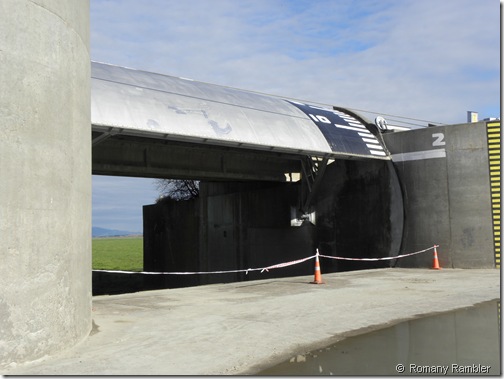
P6088030 Moutoa sluice gates

The nine steel radial gates, each 15m wide by 4.5m tall, and  weigh 15 tonnes each.  They are raised by pulleys and wire ropes, by electric motors.  The gates are opened slowly, and no more than necessary, at the right speed to keep the river at the target level.  The construction took 26,000 tonnes of concrete and 1000 tonnes of reinforcing steel, and the build cost 600,000 pounds at the time.  That’s $18 million in today’s terms. 

P6088033

P6088032 Views of the sluice gates, wide open

During a flood, the river downstream of the gates cannot carry all the water away because the flow is too slow because of a very flat gradient down to the sea.  The sluice gates are opened when needed, so that the water can flow out of the river and down the 10km floodway, which is bordered with stop banks, and bypasses 30km of low capacity river channel.  

P6088034 Exit side of the gates

Farmers who lease the Horizon owned land are given notice to safely remove stock and drop their fences down before the gates are opened.  The gates have been partially opened 39 times during flooding in the last 50 years, and only fully opened 3 times.  It is certainly an impressive structure when seen up close. In 1990 the gates were recognised by the Institution of Professional Engineers of New Zealand as having made an outstanding contribution to NZ’s engineering heritage and prosperity.

We climbed the narrow stair case to view the control room, with a bank of buttons all ready for action.  But not today, the sun was shining, and there was no sign of flooding at all.
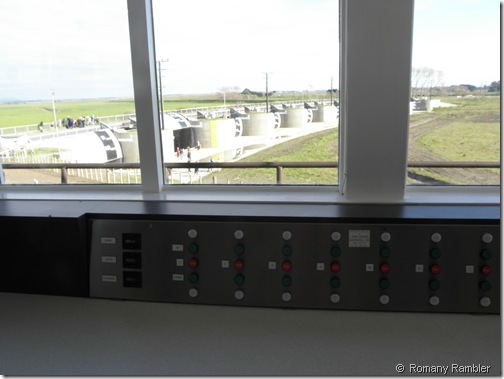
P6088031 Through the control room windows

Work is done continually on the stop-banks.  Silt removal is ongoing, and willows are planted, layered, and trimmed when they get too large.  Various types of willows are used, including Japanese willows, which are resistant to salt water.

DSCF5630 Japanese willows to be planted on the river banks

At the end of our tour we gratefully enjoyed a cup of coffee and a muffin, just what we needed to recharge the batteries.  While we were munching on our muffins we noticed a line of vintage cars driving by, all off on a Saturday drive, no doubt.

DSCF5632 Taking a Saturday drive in the sun

Then it was time to board the bus for our return journey.  What an interesting morning it was.  Next time we drive along this road which links Shannon and Foxton and cross over the bridge, we will know exactly what that strange metal and concrete structure is.

DSCF5636

Friday, 7 June 2013

GPS Mapping Trial

Recently we did a trip through the northern Wairarapa to attend a Heretaunga Caravan Club rally at Carterton Holiday Camp.

I have downloaded a map of our trip from our Garmin GPS into Garmin Basecamp program on the laptop with the intention of posting on our blog. The process was a bit convoluted as I had to create the map first in Basecamp, then print it, and then scan back onto the laptop as a Jpeg file just so that it can be loaded onto the blog.

So here goes:
QB Route0001

Not to bad really. Look out for our next trip. Maybe by then I will have figured out an easier way of achieving the same result.

Wednesday, 5 June 2013

Look at Me!!

Our cat Muffy is rather like a naughty child at times.  We were both busy doing “stuff” and she couldn’t find a lap to curl up on.  After wandering around and making pitiful noises she decided that she really would get our attention, one way or the other.  So what did she do?  Jump up on the wall unit, and carefully wind her way round behind the tray of coffee pots.  Then she was stuck.  “Help, help”, she cried, “look where I’ve got stuck”.  By the time I raced to get my camera she had worked out that she needed to back up to get out of the tight spot.

DSCF5599 Coming out backwards

We’ve just attended our first visit to a Probus group – something we had planned to do since moving up to Levin.  By a co-incidence, I was seated next to the President at the movies several weeks ago, who told me of meetings times, what the group gets up to, and encouraged the pair of us to come along to the next meeting.  And very interesting it was too.  There were two speakers, the first being a club member who was a doctor in his working life.  He told us all about the scourge of tuberculosis, which has been around for thousands of years.  Just think of the Victorian ladies slowly dying of consumption, which  Bronte sisters succumbed to.  Sadly, TB is yet another disease which is becoming drug resistant.

The guest speaker was a Vet who had the hall in stitches as he related tall tales from his student days, and his time as a brand new vet.  In between the funny stories, there were sad endings too.   And he related the statistics that unfortunately many vets are particularly prone to alcoholism, depression and suicide.  The Probus club members were very friendly, and we met up with a couple of people we know from caravanning, who did not realise that we had moved up this way.  We will certainly return next month, and have already filled in our membership application. 

Now, what is that cat up to?  There she is, on top of the couch, watching me with her beady eyes.  OK Muffy, we’ll sit down in front of the telly now, and you can choose which lap you would like to curl up on.

DSCF5601 It’s time for a cuddle now

Tuesday, 4 June 2013

Fun and Games at Carterton

Our caravan rally weekend at Carterton is now over, but we certainly got up to some fun and games.  The Carterton Holiday Park  is one of our favourite places to stay, and Pete and Di always make us most welcome.  The camp is always well maintained and the golden autumn leaves looked so inviting – we were almost tempted to roll around on the ground and throw them all over ourselves!  So just what we get up to over the weekend?

DSCF5570 Golden leaves at Carterton

There was plenty of eating going on, starting with a meal out on Friday evening at “The Marquis of Normanby Hotel”.  The Marquis, George Augustus Constantine Phipps was born in England in 1819.  He had an illustrious career, and  was made Governor of Nova Scotia and Queensland, before becoming Governor of New Zealand from 1874-1879.  The hotel was built during his time in New Zealand as Governor, but was burnt down in 1924, and was rebuilt on the same site.  The Marquis moved on to become Governor of Victoria, where he  gave final approval for the hanging of outlaw Ned Kelly.  Our group of happy campers enjoyed our very reasonably priced meals which were served to us in the private dining room.
The Marquis of Normanby Hotel

We helped Geoff celebrate his recent birthday with a delicious home made birthday cake made by Eileen.  And then “Camp Mother” Di kindly baked a fruit cake and presented it to our club members, which we ate for supper on Sunday evening.

DSCF5580 Happy Birthday, Geoff

The Rally Captains had some games organised to keep us occupied over the weekend.  Saturday evening was Bingo night, and we all brought along a collection of 10 cent coins for the Bingo cards.  Selwyn really looked the part of Bingo Master with his dinky little wind up contraption to mix the numbered tokens up.  Most of us managed to win a line or two, or scoop the pool for the house.  Barbara, however, was pipped at the post by yours truly in the very last game, and she unfortunately was the only player who hadn’t managed a win all evening.  Never mind, at ten cents a card, our winnings didn’t really turn us into overnight millionaires.

DSCF5578   Selwyn rolling the balls

More games tested our brains on Sunday evening, when we were put into teams.  Our team had three ladies plus Robin, who came in very handy when we had to remember the manufacturer’s names of cars available in New Zealand.  Then the ladies brains came to the fore when we had to work out what items in the pantry have a medicinal use – everyone knew about ginger for travel sickness.  Various questions were called, as we feverishly wrote down the answers.  And yes, our team beat their team!

Our friends Geoff and Pauline, fellow travellers on our South Island Odyssey Trip last year were also in the Wairarapa over the weekend.  They were staying at Masterton Motor Camp with their own caravan club, so we popped in for a visit.  They now have a new addition in their family, so we were introduced to their new dog, Charlie the Schnauzer. Charlie had recently been to the dog groomer, and looked very smart indeed with his latest hair cut.  The coat on the body is kept short, and Charlie sports a fine set of whiskers and bushy eyebrows. 

DSCF5575 Charlie the Schnauzer

A walk up the road one morning to the local bakery for a loaf of fresh bread took me under a large gum tree full of tuis.  They were busy feeding and making quite a racket as they hopped from branch to branch sipping  nectar from the flowers.  These lovely native birds were known as Parson birds by the early settlers because of the tuft of white feathers at the neck, which resembled a parson in clerical attire.

DSCF5555 Tui in a gum tree

As our three day weekend came to an end, we reflected on how good the weather had been, with none of the expected severe frosts which the Wairarapa is prone to.  Then it was time to pack up, break camp, and head off to our various homes.  Ours was one of the longer trips, a 156km journey taking us through the northern Wairarapa, up and over the Pahiatua Track, and back via Shannon to Levin.  It was a great weekend, made all the better with the good company of friends.

DSCF5572 Camping at Carterton