Success is getting what you want; happiness is liking what you get
Showing posts with label Power Station. Show all posts

Monday, 1 May 2023

Weekend at Shannon

We spent the weekend with the caravan club at Shannon School.  Being a school day, there was supposeably no entry to the grounds till 4.00pm, but I suspect most were on site earlier than that.

P1020580

Shannon School

It was a bit of a tight squeeze through the gates, and we were parked up on two adjacent areas.  For those, like us, with longer vans, it took quite a bit of maneuvering to slot into place.

P1020581P1020582

We all managed to squeeze in

Once we got organised, and the legs wound down, Gemma found the caravan wardrobe door open and squeezed inside for a while, she loves these kinds of hidey holes. Just look at that cheeky face peeking out.

P1020579

Here’s looking at you, Mum

The use of the hall was included in our fees for the weekend, and we gathered there on Friday evening.  Some of the longer term members were encouraged to reminisce about the early years of the club, places we had visited, things we had got up to in our younger years.  And how the clubs had changed over time, with several of the local clubs no longer in existence.

On Saturday afternoon Robin and I had planned a mystery tiki tour of the local area, to conclude with a BYO afternoon tea.  Cars were shared and off we went.  First stop was quite a marvel of engineering, the Moutoa Sluice Gates.  These were built in 1962 as a flood protection measure.  The Manawautu River here runs very sluggishly, and when in flood the river would overwhelm the stop banks and flood farmland.  The sluice gates cause much of the river flow to take a short cut, bypassing 30km of low capacity river channel, directing the flow down the 10km Moutoa Floodway.  This happens about every fifteen months or so.

P1020585

Moutoa Sluice gates

Back down the road a short way we stopped again, at the site of the WW11 Whitaunui Military Defaulters Camp, one of two in the area.  Sadly, nothing to see now, but in it’s time the two camps housed 250 conscientious objectors. The huts used to house the men were built by the Public Works Dept., mostly two men huts measuring 8ft by 10ft together with some single men huts.  The unheated huts were furnished with beds and straw mattresses, a pillow, and old army blankets.  The men were also provided with a small table and stool.  You could imaging how cold the winter conditions would be.  The men were required to work in wet conditions, cutting flax.  One of the more famous detainees was Rex Hilary, brother of Sir Edmund Hilary.

P1020604

Photo of the huts at the Detention Centre

Back in the cars again we headed up to the hills for our final stop, the Mangahao National White Water Centre.  No races down the river this day, of course, but we could see the overhead rails all in place.  Thousands of man hours were poured into making rock groynes, clearing out the river and establishing the site.  Throughout the 70s and 80s the Mangahao White Water Park hosted dozens of successful events.  Over the years the park has been upgraded to international standards, and training takes place here by locals and international teams.

P1020596

Part of the course

There were handy picnic tables on the river bank so we settled down to enjoy our afternoon tea.  Out came the thermoses, the coffee and biscuits, and we all soaked up the peaceful atmosphere.

P1020588P1020589

Afternoon tea on the river bank

There were walks to be had, down the path along the river, or up the road to the nearby power station.  That’s the way I went, over the bridge to view the rather old building.  The Mangahao Power Station was opened in 1924 and continues to provide power to the National grid.

P1020597

Mangahao Power Station

This was the last stop on our mystery drive so we made our way back to the school and 4zees time.  In the evening we gathered back in the school hall for another get together.  Most were happy to chat the evening away, while others played a game of snakes and ladders on a rather large floor mat, tossing a big foam dice around to see if their points took them climbing up the ladder or sliding down the snake.

P1020602

Saturday evening sun set

After Sunday morning tea we packed up and headed for home.  I was intrigued by the school skate boards and helmets all lined up in the hall passage waiting to take the students on rides around the school grounds.

P1020603

Ready to roll

It was a great weekend away, with most of our members attending.  Good fun, and not too far from home. for us.

Thursday, 25 April 2019

On to Hamilton

With the Easter Rally over, it was time to pack up and leave Mt Maunganui College, with some of our fellow campers getting away bright and early.  We left later in the morning, not in too much of a hurry as we had a reasonably short trip to Hamilton.  And as we hadn't traveled along this road before, we took SH29 over the Kaimai Ranges.


We stopped for lunch at Hora Hora Domain, a free camping area.  Such a pretty place, with many large shady trees in a park like setting and overlooking  Lake Karapiro.  An hour or so later, fed, watered and well rested, we continued on our journey again.

Lunch at Lake Karapiro

Our trip to Hamilton was to get a leak checked in the caravan.  Luckily we could stay at the Leisureline factory overnight, so the servicemen can take charge of our van at 7.00am the next morning.  We are very grateful that the service department could fit this job so quickly, especially as we are up on this part of the country this week.

Staying at the Leisureline factory overnight

What shall we have for dinner, we wondered, maybe Chinese?  Robin did a bit of googling, read some reviews, and we drove a few kms to Golden Dragon Restaurant.  The food was great, very reasonably priced, and we were offered the Senior Discount too.  You know it must be very good, when it is packed with local Chinese patrons.  I tried a couple of new things too, pork dumplings, and on the dessert table, tapioca coconut milk to pour over my pudding.  We were chatting to a couple of locals who were at the next table, who commented that although it wasn’t the flashiest restaurant in town, the food and prices more than make up for it.

Plenty of choices

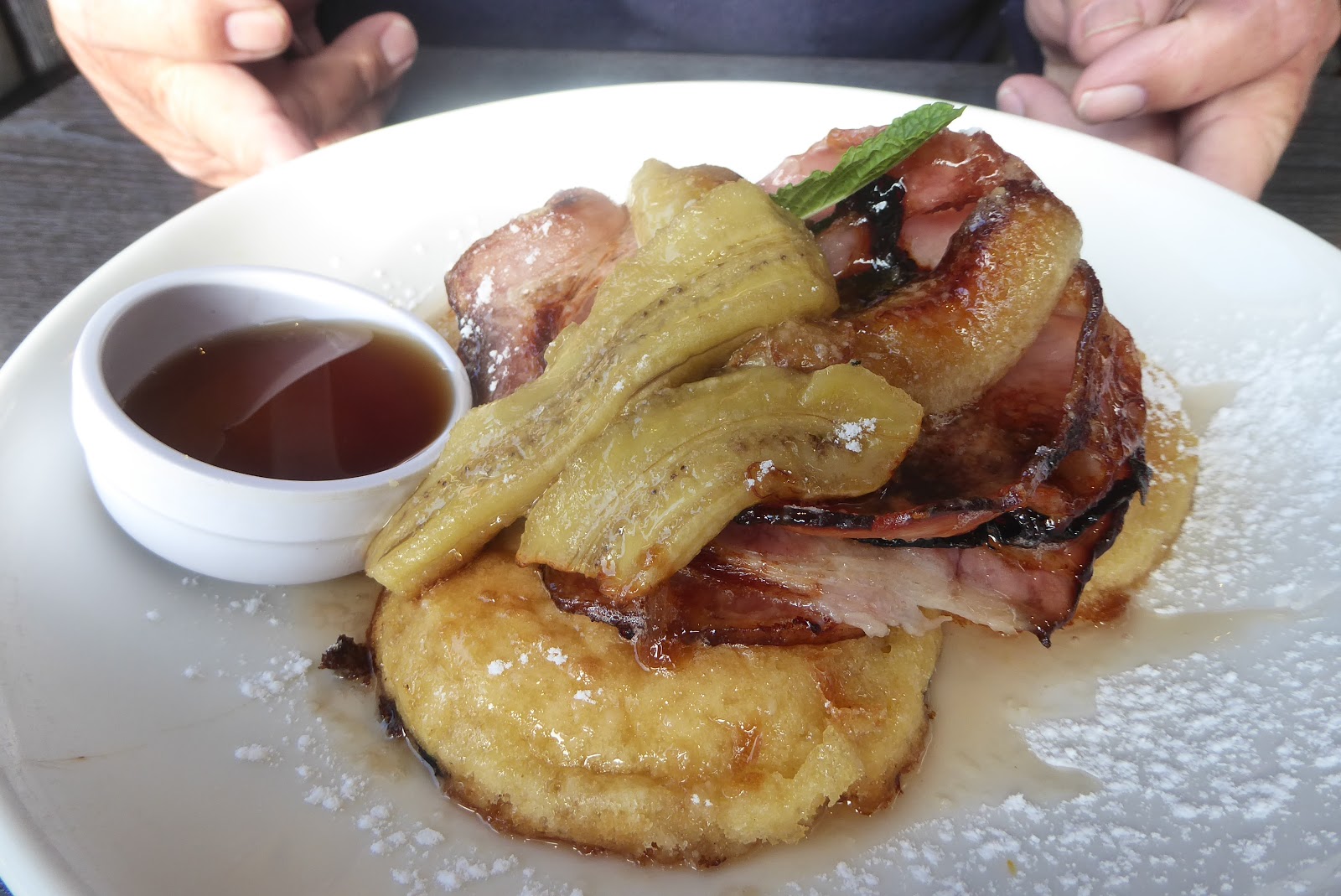
Up bright and early the next morning we left our caravan with the servicemen and took ourselves off for breakfast.  This was certainly  delicious and beautifully presented too.  Salmon and avocado for her, and pancakes for him, followed by a delicious coffee.  Sure beats our usual cereal and toast!

Our delicious breakfasts
The caravan was ready for collection  mid morning so we hooked up and went on our, stopping off at Taupo Airport NZMCA Park for the next two nights.  This is always a busy place to stay, vans arrive and depart,  helicopters come and go, planes arrive and take off at the adjacent airport, and sky divers jump out of planes to land nearby. 

It had been a while since we had witnessed the Aratiatia Rapids change into a turbulent monster.  Several times each day, spill gates from a dam are opened at the top of the rapids and the narrow gorge fills with water surging past at up to 90,000 litres per second.  At Aratiatia the Waikato River falls naturally through 28 metres in the space of one kilometre. This natural drop has been harnessed for environmentally-sustainable hydroelectric power - headwaters are diverted through a tunnel to the power station.

We stood on the bridge by the power station, the siren sounded several times and the water flow changed.

:
From this

To this

On the other side of the bridge there was a lovely view of a  small rapid dotted with rocks covered in river weed.


As the water came rushing through, the rocks disappeared from view.


Once the spill gates were closed, and the water slowly dropped to normal, we heard voices from the main look out site, and witnessed a canoeist into the water!    And here he comes.


He paddled down under our bridge, climbed out of the river, pulling his boat behind him, then settled down to await his friends to collect him.  Oh dear, highly illegal and so dangerous.

Monday, 22 January 2018

Where to Today?

We did a bit of a “Grand Tour” today – it certainly seemed like it, travelling far and wide to places unknown, and covering about 150kms on our round trip.  One thing we did notice were many of these pumps/pipes on farms as we passed by, presumably to get artesian water from the water table for irrigation.  If we are not right in our assumption, please feel free to correct us.

P1140224
For artesian water, we think

First stop was up SH77 to Methven, (a place we had been before), which had the feel of an alpine village, not unlike Ohakune in the North Island.

P1140054

There were two large pubs on opposite sides of the road, the Brown Pub, and the Blue Pub, both vying for business in their own ways.  The Brown Pub was selling itself as “your true country pub”, while the blue pub was more trendy and part of a large resort.  With Methven not too far from the Mount Hutt Ski fields, there is sure to be plenty of customers for both.

P1140073P1140071
Brown Pub and Blue Pub at Methven

P1140062 
Magnificent War memorial at Methven

Climbing the hill out of the Rakai Valley, we stopped to take in the wonderful views.

P1140119P1140123

P1140126
Views over the Rakaia River

We were making for the Lake Coleridge Power Station, the first large powerhouse built by the government, completed in 1914.  The construction was a remarkable feat for that time, as it was built on loose shingle of the Rakaia River, which lead to many engineering problems which needed to be solved.

P1140146

P1220756
Front and back views of the power station

There was a large info board to read, and old bits and pieces from the power house artfully displayed.  The intake pipes from Lake Coleridge snaked down the hill deliver the water to the power house.

P1140162
Intake pipes

Once we had seen the power house, we had to go and find the lake – and off we went, bouncing along a narrow, winding, unsealed road.  Must admit we were surprised to see several cars of tourists when we arrived, we really felt that we were all alone as we travelled along.  Swimmers and boaties were warned to be aware as whirlpools form by the intake area.  Fishing is allowed, with chinook salmon, and both brown and rainbow trout in the lake.

P1140177P1220758
Lake Coleridge

Back on the rough road we went, kicking up a dust trail behind us.  But look at this wonderful view – it certainly is desolate mountain country.  Then we had to turn left at Dog Box Corner.

P1140183

P1140189

Turning off the dirt road we joined SH72 and stopped briefly at the quaintly named village of Windwhistle.  These day it is just a shadow of it’s former self, with only a school and a mechanic’s garage there now.  Windwhistle takes it’s name from the fierce gale force winds which regularly occur. 

I wanted to stop further along the road at Glentunnel as I had read about the “world famous in New Zealand” Public Library and Post Office, and what a gorgeous little building it is.  The local citizens raised money to build the library on land donated by Mr Deans of Homebush.  Built by Thomas Lamport, the building incorporates every type of brick and terra cotta tile then produced by the Homebush Brick Tile and Pottery Works at Glentunnel, using local clay. Sadly, the library was not open so we could not have a look inside.

P1140196
Glentunnel Library and Post Office

Like so many of these small towns, Glentunnel had a history of coal mining, as their welcome sign shows.  The coal mine opened in 1872, the men working with the picks and shovels used in those days.  The mine finally closed in 1938.

P1140205

Driving through Hororata we passed the St John’s Stone Church which was badly damaged in the 2010 earthquakes and is yet to be repaired.  Then we finally joined the busy SH1 and we were back in Ashburton and the quiet and peace of our POP with the chickens and miniature ponies once again.  It was another great day spent sightseeing.

Friday, 5 January 2018

Exploring Roxbugh

After thunder and a heavy downpour the previous night, we woke up to a misty morning.  Not too hot, so it was a good day to go exploring.  And the first thing we found, almost on our back yard,  was a tiny little power station with water piped down the hill to feed it.


Teviot Bridge Power Station

From our campsite we could look across to the hills to see one of the several places where the devastating November 2017 flash floods brought down rocks and debris.  Stake Highway 8 was damaged north and south of Roxburgh, with large volumes of debris.   The flash flooding closed roads, leaving the small town isolated and without water with residents cleaning up mud and silt. 


Rocks and debris roared down the hill and down to the river blocking the wide drain

The damage caused the very popular Jimmy’s Pies to close for a week or so and we remember that the reopening made the news.  So we just had to put Jimmy’s Pies on our list for items of interest in Roxburgh.  As expected it was very busy indeed and we purchased two pies for our evening meal.  The business started in Invercargill in the late 1940s and moved to Roxburgh in 1960.  Still family run, the fourth generation is still making pies using the same original recipe and natural ingredients.


Statue of the original Jimmy the baker and his “world famous in Roxburgh” shop

Even the gutters are interesting in Roxburgh as they seem to be laid with slabs of rock.


Roxburgh gutters

As far as public toilets go, (very necessary for the traveling public and locals out shopping) some can be downright nasty.  Not so in Roxburgh – they were bright and shiny and very modern, with doors which talk to the patrons as they close and reopen.  The lovely sculpture close by was made by local metal artists Bill and Michelle Clarke.  They  created the  1880s-themed scene next to public toilets, which took six months to create, at a cost of $50,000.


Sculpture of mining family

We then travelled to view the Roxburgh Dam, just a short 9km drive from town and very accessible.  The Roxburgh Dam is the earliest of the large hydroelectric projects in the southern South Island, and lies across the Clutha River.   The dam contains over 1.5 million tonnes of concrete with eight turbine generator units.  Lake Roxburgh, formed by the dam, covers an area of nearly six square kilometres. Lake Roxburgh is popular for fishing, kayaking, jet boating and water skiing, and salmon and brown trout can be caught in the lake year round.


Traffic could drive across the top of the dam, so of course we did.

There are signs of the rail line from earlier years, and this old goods shed.  The line was originally started to get into the gold mining areas in Otago, but was completed through to Roxburgh mainly for the carriage of fruit.  Originally known as the Lawrence Branch, it was one of the longest construction projects in New Zealand railway history, beginning in the 1870s and not finished until 1928. The full line was closed in 1968. 


Old good shed

We stopped to look at an unusual site on Loop Road, an old stone building in disrepair.  What could it be, we wondered?  It was such a massive size, and if we were in England we could almost blame Henry VIII for it’s ruin. Mr Google told us that the Teviot Woolshed  was erected in 1870 and was once the largest woolshed in the southern hemisphere. Measuring 137 by 47.3 metres it could hold more than 8,000 sheep. Stories suggest the shed came from England, where it had been a railway station before being dismantled and shipped all the way to New Zealand.  A fire in 1924 destroyed much of the shed, with just  the stone walls with rounded façade and arched windows remaining today.


Remains of the stone Teviot woolshed

Faigan’s Café at Miller’s Flat had been recommended to us for lunch, so that’s where we were heading for.  Situated close to the very popular Rail Trail, cyclists hobbled off their bikes looking for a little R&R before continuing on their trip.  The café was very accommodating, and supplied bike racks outside for his cycling customers.  The food was great, (Faigan’s Hamburger for him, and pulled beef Open Sandwich for her) the coffee was excellent,  and we loved the use of old stenciled timber crates in the decoration.  What was really nice was the fact that Mike greeted each customer as they entered, and took the time to farewell them when they left.


Lunch at Faigan’s Café, Miller’s Flat
.

Just along the road was the War Memorial dedicated to the fallen men of the area

After all this sightseeing we stopped off to buy some eggs from one of the local producers.  Then it was time to head back to our van, put the kettle on, and relax.  We had a great day exploring the area.