Success is getting what you want; happiness is liking what you get
Showing posts with label Seals. Show all posts

Saturday, 7 March 2020

Ngawi and beyond

The weather was wet, rough and blowing a gale during our second day at Cape Palliser, no gathering outside for us.  After lunch things started to improve so we headed off to Ngawi, a small fishing village  just a short way up the road.  Ngawi has more bulldozers per capita than anywhere else, we read.  The bulldozers are used to haul fishing boats into and out of the water as there is no wharf or other access to the ocean other than the beach, which can be notoriously rough.  Ngawi is known for its exposed climate, its intense and prolonged wind and the fact that there are almost no trees nearby. The weather can be extremely hot in summer.  We parked on the shingle and went to check them out, beside the shiny red bulldozer dwarfing our car.
P1340228

P1340253P1340251
Bulldozers and fishing boats on Ngawi Beach

It was a few kms up the road to  see Cape Palliser Lighthouse,  perched high on a cliff, and owned and operated by Maritime New Zealand.  The lighthouse  was built in 1897 and was originally fueled by oil.  Several changes were made over the years, the oil lamp was replaced with an electric one powered by a local diesel generator,  later replaced by a connection to the mains grid in 1967, and the light was fully automated in 1986 and is now managed from a control room in Wellington.

P1340232
Cape Palliser Lighthouse

The base of the lighthouse is reached by climbing a staircase with 258 steps, up a 58 metre cliff. The staircase was built in 1912, and replaced a dangerous dirt track.  We decided not to climb the stairs this time, although we certainly did on our last visit here.  There were a couple of brave souls climbing very slowly down the steps, we noticed, perhaps they were having knee problems too?

P1340229
The steps up to the lighthouse

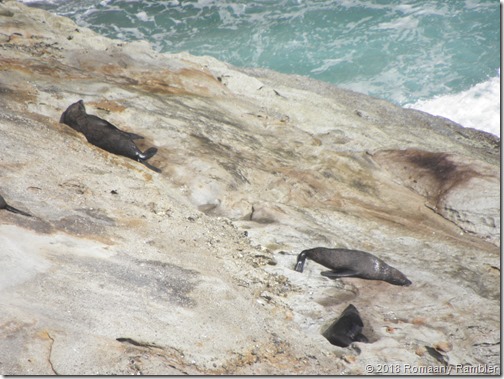
There is a large fur seal colony in residence at the cape with the breeding season from mid-November to mid-January.   We saw seals on the rocks, and laying about, looking  fat and contented,  on the grassy shore.

P1340246

P1340249P1340241
New Zealand Fur Seals

This sign certainly piqued our interest- wonder where the house owner got it from?  We are sure there is no ice on this shore, falling or otherwise!

P1340234
Sign at the beach

Our trip to the end of the road to see the sights  certainly blew the cobwebs away.  Then it was time to head back to camp and put the kettle on and warm up with a hot drink – this area has rather bracing conditions! 


Saturday, 17 February 2018

To the end of the Unsealed Road

Heading north on Friday we left busy Takaka behind and arrived at Collingwood – this  town is an ecotourism destination due to its proximity to Kahurangi National Park and Farewell Spit Nature Reserve.  Originally named Gibbstown,  the settlement was later renamed Collingwood after Admiral Cuthbert Collingwood, Lord Nelson's second-in-command at the Battle of Trafalgar in 1805.  Gold was discovered in 1856 and the town's population surged, and it was suggested that Collingwood should become New Zealand's capital. But a more central location was preferred for the capital and the recommendation was for Wellington.

P1160824

Although fires have raced through the town several times in the early years, Collingwood has retained some interesting old buildings.  The original  Post and Telegraph Office was a very grand building in it’s time, although postal business is now done through the general store.  And the old Court House is now a thriving café, filled with customers sitting outside under the shady umbrellas while they sipped their lattes.  Collingwood is much smaller and without the frenetic pace we found at Takaka.

P1160825P1160832

It was another 10kms up the road to get to our destination, the Old School Café and Bar at Pakawau, another POP which had been recommended to us.

P1160838

The POP has a nice grassed area and was fairly full when we arrived, and Robin expertly backed the caravan into a space.  Several more vans arrived in the afternoon, so things were rather cozy.  A group of campers were collected from the gate to go on a Farewell Spit Tour in the afternoon.  We did this tour quite some years ago, and booked the tour while staying in Nelson – if we had thought about it we should have camped a lot closer.  The alarm was set for 4.00am, and off we set in the car, driving for miles in the dark, over the rather nasty Takaka Hill, all the way up to Collingwood.  The timing of the trip depends on the tide, so that was why we had to set out so early. 

P1160836

After settling in, and having lunch, we set off to find the famous historic Langford Store at Bainham.   The store has been in the same family four generations, since it opened in 1928.  EB Langford was the initial proprietor, followed by his grand-daughter Lorna who ran the store and post office for 63 years.  Lorna retired in May of 2008, handing over the reins to Sukhita Langford, who hopes to do both the community and family proud by continuing the traditions that her great grandfather instilled more than 80 years ago.  Sadly, we couldn’t enter the shop, and sample a delicious afternoon tea which the shop is famous for.  The shop is closed on Fridays (why Friday, we wondered?) so all we could do was take a photo and peep through the windows.

P1160811
The historic Langford’s Store

A little further up the road was Salisbury Falls – to get there we had a short trek over the paddock, climbing two stiles, then down a rocky path.  There was a family frolicking in the river, having a great time on yet another very hot summer’s day.

P1160793
Salisbury Falls

On Saturday morning  there was a general exodus from the camp, and we were the only ones left behind.  But never mind, we were going out and about again, and there were sure to be some more neighbours when we returned.  The day was overcast and windy, but still rather warm and muggy.

P1160852
All alone at the Old School Café

We decided to travel north, as far as the road would take us.  The sealed road finished at Puponga and we decided to turn left and travel along the unsealed road to Cape Farewell, passing by Old Man Rock on the way.  It certainly was an impressive rock!

P1160857
Old Man Rock

The Cape Farewell car park was quite busy, and we trudged up the hill to the lookout point.  And joined the other tourists all looking over the rail at the  rather impressive sight in front of us.

P1160869
Cape Farewell

The sea was surging in endless waves and over the rocks.  We looked down to the seals far below.  Some were sunning them selves on the rocks.  And another group were gently bobbing about in the waves, they didn’t seem to be feeding, just enjoying themselves and having fun. 

P2170977

P2170979P2170983
Seals having fun

P1160878
We’re having fun too

Back to the cross road we went, and turned onto the other unsealed road, which took us to the Farewell Spit Information Centre and Café.  We ordered a coffee and date scone and sat on the balcony looking over the spit.  There were large black birds bobbing about off shore, and surprisingly, they turned out to be black swans.  We were surprised to find them in the sea, thinking they were fresh water birds, but according to our bird book, it mentioned that they were found in the tidal waters, including those  east of Farewell Spit.

P1160886

P1160891P2170987

Farewell Spit has been a bird sanctuary since the 1930s and provides a home for over 90 bird species. Bar tailed godwits, knots, curlews, whimbrels and turnstones fly around 12,000 kilometres every northern hemisphere autumn to spend the summer here in the south. The spit also has a gannet colony.  To guide passing ships, Farewell Spit's first lighthouse was built in 1869. In the early years the lighthouse site had no vegetation and windblown sand was an ongoing problem for the keepers. Then one clever keeper organised for small loads of soil to be delivered with the mail. He planted a windbreak of macrocarpa pines which are still there to this day. The pines protect the station from the shifting sands and provide a daylight landmark for passing ships.

P2170985P2170990
Views of the sandy spit from the café balcony

We are so pleased that we have driven to the end of the road north on the South Island.  Rutted and rough it may have been, but the 4WD coped well.  With our sightseeing trip over for the day, we drove back to the camp for some late afternoon R&R – and we were no longer alone, several vans had arrived while we were out.

Sunday, 28 January 2018

Akaroa Harbour Cruise

A morning on a harbour cruise to check out the wildlife sounded like fun.  With boarding passes in hand we waited patiently for the boat to arrive.  The boat was licensed to carry 99 passengers, we were told, and with a big group of Asian school kids arriving, there certainly seemed to be a full complement.

P1140606
All aboard the Black Cat

The morning started with the usual safety briefing drill, no running, no smoking, keep children under control, and whereabouts of life jackets.  All quite necessary, and the the skipper took us around the harbour, checking for wildlife to show us.

P1140690
Our trip

P1140636
We saw some New Zealand Navy Seals being put through their paces

And farmed fish business is alive and well in this area.  We saw rows of mussels growing and further out, a salmon farm.  Young mussels grow through stockings, anchoring themselves to the ropes with their strong beards. The farms are usually located in sheltered or semi-sheltered areas where there is sufficient depth of water at low tide to keep the longline droppers off the bottom. Salmon farming takes place in large floating net cages, moored to the sea floor in clean, fast-flowing coastal waters. Young fish from freshwater hatcheries are transferred to cages containing several thousand salmon, and are harvested when they are about two years old, weighing 2.5 to 4 kilograms.

P1140679P1280796
Farming mussels and salmon

The passengers were all hoping to see wildlife and we weren’t disappointed.  The small Hector’s Dolphins were difficult to photograph as they raced through the water, swimming alongside the boat, zipping underneath, then reappearing again.  Hector’s dolphins are among the world’s smallest marine dolphins, found only in the inshore waters of New Zealand.  They are the only dolphins in New Zealand with a rounded black dorsal fin. Their bodies are a distinctive grey, with white and black markings and a short snout.

P1280787
Hector’s dolphin

P1280808
Giant Petrel

Traveling close to the cliffs we saw Elephant Rock, can you make him out?  Plus sea caves and other interesting rock formations.

P1280797

P1280793P1280795
Rock formations

Everyone rushed to look at the babies – cameras were clicking madly as the boat quietly eased closer to the nursery rocks.  These are New Zealand fur seals, and when the sealers arrived in force during the 1790s, the demand for seal-fur hats, seal-leather shoes, and seal-oil for lighting, almost had them hunted to extinction. With a complete ban on sealing after 1894, they are making a come-back.

P1280817

P1280816
New Zealand fur seals

Robin had been standing up at the bow of the boat taking photos for most of the trip, and finally came inside to warm up.  And there on the wall was a great picture of a Hector’s dolphin, showing it leaping out of the water.

P1140780P1280819

We then did a little more exploring, driving to Duvauchelle Hotel for lunch. The hotel was badly damaged by the earthquakes that struck the region in 2010 and 2011. The oldest parts of the hotel were demolished after the earthquakes, the remaining parts of the building were reopened as a single-storey establishment in September 2013.  Our lunch was delicious, pork spare ribs for him, and belly pork for her, and the prices were very reasonable too.

P1140804P1140784
Lunch at Duvauchelle Hotel.

There must be something about little old Post Offices, as we have found several during this trip, then lo and behold, there was another one.  This little beauty served as the Robinsons Bay Post Office from 1912 till it closed in January 1960.  It was the smallest Post Office building in Canterbury.

P1140826
The former Robinsons Bay Post Office

Wednesday, 20 December 2017

Moeraki Boulders, Seals, and a Lighthouse

The Moeraki Boulders are well worth a repeat visit (or two or three) just because they appear so mystical and unusual, and we couldn't drive past without stopping.  The local Maori tradition says that the boulders are the flotsam cast from the wreck of the voyaging canoe Arai-te-uru, which foundered while travelling south in search of greenstone.  The boulders are a short drive from where we are staying, and always very popular with tourists.  The car park was fairly full, and the beach was alive with people looking at, photographing and clambering over the boulders.

PC200486

They are in fact known as septarian concretions, formed over millions of years on the sea floor.  The seabed was uplifted to form coastal cliffs, which have eroded over time, and the boulders have tumbled onto the beach. There are big boulders, baby sized, some showing the various segments, and others which have split open.

P1100696P1100714PC200481

PC200480

We found one boulder half exposed in the bank, no doubt it will roll down onto the beach sooner or later when enough of the bank has been washed away.

PC200483
Boulder partly exposed in the cliff

Then we drove to Shag Point as we had been told there could well be seals on the rocks. Aren’t they cute - the little one kept gazing up at us, just like a friendly puppy.

PC200488PC200489
Seals at Shag Point

Fronds of bull kelp swirl around the coast and can grow to a length of 10m.  In the 1970s bull kelp in this area was harvested, processed and dried and sent to Japan for sale.

P1100733
Bull kelp growing on the cost at Shag Point

High on the hill overlooking the village was the Moeraki 150 Year Memorial Lookout.  On this hill stood the lookout and signal mast of the whaling station founded by John Hughes and his party.  The lookout had a sea view of 360 degrees.

P1100803
Memorial Lookout

We hadn’t yet finished exploring Moeraki and drove down the very rough and rutted Lighthouse Road to reach Katiki Point Lighthouse.  The lighthouse was built after several accidents on the dangerous reefs and the light first shone from here on 22nd April 1878.  The wooden tower stands 8m high and 58m above sea level, and the light can be seen for 10 nautical miles.  The original lens operated with a 1000 watt lamp, but was fully automated in 1975 and the lighthouse keeper withdrawn from service.

P1100895
Katiki Point Lighthouse

A brisk walk along the path of the Katiki Historic Reserve took us to the point.  The sea was crashing onto the rocks, as we peered over, being aware of the signs to keep away from the unstable cliff edges.

PC200497

Tiny beaches were dotted amongst the rocks, and we saw seals lifting their flippers as they played in the water.  This one was sunning on the rocks and decided it was time to shuffle over to the water to cool off.

PC200499

Back at camp we found out that we had more neighbours than we could shake a stick at!  A rather large “Flying Kiwi” bus rumbled up the camp, parked in front of us and disgorged about 30 passengers.  They busily set about putting their tents up and arranging their sleeping bags.  Several woks cooking on gas rings on a drop down cabinet in the bus are now under way, cooking up a storm for the passengers evening meal.  The camp owner told me that the bus returns every two weeks with another load of passengers, they pitch their tents on the grass, cook for themselves, and leave the following morning bright and early.

P1100907P1100898
Our new neighbours