Success is getting what you want; happiness is liking what you get

Saturday, 27 January 2018

Weedons to Akaroa

We had a new neighbour beside us at the Weedons NZMCA Park, a huge bus pulled in beside us, with a large family.  This young couple had six children, aged from two up to fourteen, no wonder they needed such a big bus for them all.   The children went off to find blackberries the morning we left, and knocked on our door to present us with some of the spoils.  How kind, we will be having fresh blackberries for dessert tonight.

P1140591
Freshly picked blackberries from the neighbours

After filling up with fresh water at camp, and a visit to the dump station, we were on our way.  Akaroa – here we come.  Banks Peninsular, was named after Joseph Banks who was sailing with Captain Cook on the Endeavour in 1770.  It’s history goes back to the dawn of time and it was formed following violent eruptions of two volcanoes.  These formed the twin craters of the Akaroa and Lyttleton harbours, which have many smaller bays indenting the coastline.

P1140473

SH75 into Akaroa is windy and rather steep, so it was a slow trip, puling over when we could to allow traffic to pas by.  We stopped at the lookout on top of the hill to get our first glimpse of Akaroa harbour – it is such a delightfully pretty place.

P1140482
First view of Akaroa

What’s this – a bright red double decker bus trundling up the hill.  There must be a cruise ship in the harbour.  I would have thought that the hill was a bit too steep for this bus.

P1140495
Here come the tourists

Our POP (park over property) was up another steep hill, at Takamatua, just before Akaroa.   So we are parked up safe and sound behind a tall fence, in front of a delightful property, and surrounded by native trees filled with beautiful birdsong.   

P1140597
Here for the next three nights

Once we were organised we drove down to the cute little French Village of Akaroa.  There were street signs proclaiming Rue this and Rue that, an acknowledgment of the French immigrants who arrived, only to find that the English had already claimed sovereignty.  The French were allowed to stay, and Akaroa embraces the French influence.

P1140513P1140522
Court House from 1879, and a pretty little cottage

There were groceries to purchase, a launderette to track down and quite by accident we found the Fudge Shop that we remembered from our last visit six years ago.  After being invited to have a taste, you can work out what happened then – of course we had to buy some fudge.  Just a little, Russian fudge, and some Crème Brulee, both delicious.

P1140508
It was the tasting that made us do it 

Akaroa was so busy, with a cruise ship in the harbour to swell the visitor numbers there was hardly room to move.  We could just make out the name, it was the “Sea Princess”.

P1140539
The Sea Princess is in town

People were everywhere, walking up and down the streets, sitting outside at the cafes enjoying afternoon tea, taking photos of the sights.  There were a lot on the beach too, frolicking around, or just sunbathing.  Little boats were bobbing around and we saw the orange tender busily ferrying cruise passengers back to their ship.

P1140582
Enjoying the sun in Akaroa

Friday, 26 January 2018

Up and Away on the Gondola

We all have a wish list, and a trip on the Christchurch gondola was on mine for this current trip.  It had been many years since we last had a ride, and in the meantime the gondola was closed for two years after the devastating Christchurch earthquakes.   But it has been up and running now for some time, and the summit complex has since been revamped since the 2011 earthquake.

P1140375

We paid our money and bought our tickets – sadly no discounts for seniors.  Climbing aboard into that swinging capsule, we were soon on our way, soaring high.  Up, up, up we went, skimming the steep rocky cliffs of Mt Cavendish, and looking down on wonderful views over Christchurch.

P1140379P1140385
All aboard the gondola

The Christchurch gondola was opened in 1992, and carries passengers over a horizontal length of 862m to the summit.  The cableway was made in Austria, and the cabins were constructed in Switzerland.  A sign on the inside of the window offers this reassurance to passengers as the gondola stops every now and then, and sways on the cable.

P1140390

P1140401P1140422
Safely at the summit

The viewing platform gives 360deg views of the city, Lyttlelton Harbour, the Canterbury Plains and across to the Southern Alps.  The day was a little hazy, but even so, the views were still amazing.

P1260764

P1260765
Views from the platform.

After lunch in the Red Rock Café, (lamb pie for him, corn fritters for her, followed by coffee) we followed the other patrons down the steps to an open area where everyone seemed to be taking selfies at the cliff edge.

Gondola2

Gondola1

P1140433
More views from the top

The Time Tunnel Experience is something new, and we boarded little electric carts and got whisked away back into history.  The area had a fiery birth through volcanic activity, then we were taken through pristine forests inhabited only by native birds.  The Maori people arrived, followed by the early settlers, both on perilous journeys across the sea.  The time tunnel experience then told of the early days of Christchurch, and famous inhabitants, such as Richie McCaw, Richard Hadlee, Hayley Westerner.  Although the journey was only 5 minutes or so long, it was very well done indeed.

P1140437P1140440
Then it was time to board the cabin for our downwards journey.  Here we go – going down!

Thursday, 25 January 2018

The Circumforaneous Gibbs

It was our pleasure to meet up with fellow bloggers Dave and Nancy.  We very nearly met up a few weeks ago when we were passing through Christchurch on the way down to Dunedin, but it wasn’t to be.  This time, after a phone call, we were kindly invited to afternoon tea. 

P1140371
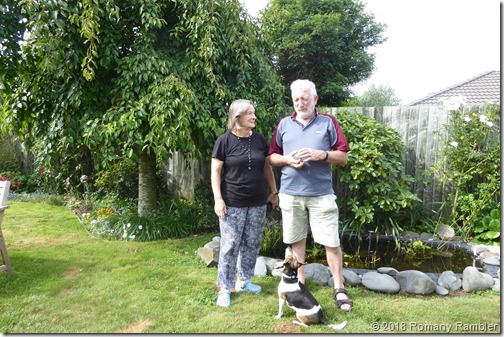
Nancy, Dave, and Penny

Penny the dog barked severely at us when we first arrived, but then settled down when she realized that we were no threat at all, and wouldn’t be making off with the family silver.  And the two Burmese cats kept us entertained by their antics, they weren’t the least bit interested in the visitors.

Dave and Nancy write their blog The Circumforaneous Gibbs and we followed them on their recent travels through Australia.  Thanks so much for arranging the get-together, it was so nice to meet you at last.

Wednesday, 24 January 2018

Having a Meltdown in Christchurch

There were a couple of jobs to do before we hooked up and left Ashburton – a visit to the laundromat and put the 4WD through the car wash.  After all those gravel dusty roads we’d been driving on, the car was rather dirty and dusty.  Then it was back to our delightful POP to hook up,  and be on our way.  Donegal Downs is such a lovely place, we would have been happy to stay much longer, but really needed to keep travelling northwards.

 Ready to move on

Our time spent in Ashburton had been great, and there are sure to be places to discover that we didn’t find – perhaps next visit.

Goodbye to Ashburton

Heading northward, we crossed the bridge over the Rakaia River once again.  The present road bridge was opened in 1939 and spans 1.8 kilometers of one of the world’s best examples of a ‘braided’ river, and the rail bridge is on one side.  These two bridges are New Zealand's longest road and rail bridges.

Crossing NZ’s longest road bridge, with the equally log rail bridge beside it

Getting closer to Christchurch City, we passed the small town of Dunsandel, which always brings back memories of that Kiwi song written by Ken Avery, “By the Dog Dosing Strip at Dunsandel I fell in love with you””.  Non Kiwis may not be aware of such things, but hydatids testing was done regularly on dogs, and I certainly remember taking my own dog to the strip in the Hutt Valley many years ago.  There are no such things these days as dog dosing strips, but the connection to Dunsandel lives on.  After an intensive hydatids control programme, New Zealand was declared free of the disease in 1999.

If possible, we like to arrive at our destination about lunch time or early afternoon at the latest.  We pulled into Weedons NZMCA Park at 1.00pm, found somewhere to park up, wound the legs down, switched the fridge on, and we were ready for lunch.  And copious amounts of water, as it was another extremely hot day.

At Weedons Park

Although not full, there was quite an array of vans parked around the edges of the large park.  And as expected, more rolled in all afternoon and early evening.  With all our tiki-touring around, Robin had to go and purchase some more Road User Charges – just to keep us legal.


It was very pleasant sitting outside after our evening meal under the shady awning, watching the day slowly come to an end.  We are under the flightpath to Christchurch Airport and plane after plane kept flying overhead as they made their descents.  The temperature slowly cooled and we watched the colours of the sunset – pretty peachy-pink against a clear blue sky.

Sunset at Weedons

As for that meltdown – the temperature here in Christchurch was 32 degrees C today, with the same promised for tomorrow.  Wow – that’s hot!

Tuesday, 23 January 2018

Last Day in Ashburton

Just a little sight seeing today, the temperatures were to reach 30C we were told, so we didn’t want to be out and about all day in the hot car.  On our way out we stopped to take a photo of an interesting old brick building down our end of town.  Now part of the grain storage facility, this building, completed in 1928, was the former Ashburton Glassworks  This venture was not successful, and the directors closed down the factory in  1931. The building remained empty until 1940 when it was used as a military training facility. The high ceilinged, partially partitioned building was warmed with coke braziers in an attempt to bring some warmth to the cold interior. Soldiers called it “Crystal Palace’ and were reported to have written their names in chalk on the walls. Over the years, the building has mainly been used for storage.

The former Ashburton Glassworks

Also, not too far away, is a sight to gladden the heart of any John Deere enthusiast.  A whole range of those green and yellow machines sitting outside, waiting to be taken home to live on the farm.

John Deere machines galore

Our trip today was to the Rakaia Huts down by the coast – just because we had never been there before.  Down dusty dirt roads we went, finally spotting the Welcome sign.

Welcome to Rakaia Huts

I’m not sure what we expected to find, probably a collecton of ramshackle fishing huts on the coast, but we were quite wrong.  The little village was full of permanent homes, most of them very modern, with some older ones quite well maintained.  We drove to the end of the road to look out over the water.  We couldn't actually see the coast  as there was a large shingle bank between the road end and the sea, but we could certainly hear the waves crashing onto the shore.


End of the road at Rakaia Huts

One of the neighbours obviously enjoys fishing and has a sense of humour.  The sign on his boat propped up on rocks in front of home declares:  “To board you must bring 3 doz Corona, 2 kilos whitebait, 3 salmon, 2 trout, 2 flounders and some ducks”.

Moore’s Ark

Driving back down the dirt road to Rakaia Robin quickly stopped the car, reversed back as he couldn’t believe his eyes.  Just what was that bare bottom doing in the front paddock?  Seems that the larger than life sculptor was of a mother with her baby on her back.  Goodness knows why, but it certainly makes a statement.

Sculpture in a rural garden

It’s all go out in the country, and we had to stop as a herd of cows crossed the road – it must be milking time.

Hello cows – be careful crossing the road

And then we saw the dust being kicked up in the distance, getting ever closer.  Quick, shut all the windows tight till the truck goes past.

Here comes a truck

We made it safely back to Rakaia township, and stopped to admire the large fibreglass salmon which marks the entrance to the town.  The river from which the town takes its name is known for its salmon fishing and jet boating.

Symbol of Rakaia – the leaping salmon

We finished our day out at the adjacent café with a cool drink – we were just about melting.  And the chilled bottles of water freely available to customers went down a treat too – we certainly needed rehydrating on such a hot day.  Then it was back to our camp site in Ashburton to sit, relax, and cool off in the shade.

Monday, 22 January 2018

Where to Today?

We did a bit of a “Grand Tour” today – it certainly seemed like it, travelling far and wide to places unknown, and covering about 150kms on our round trip.  One thing we did notice were many of these pumps/pipes on farms as we passed by, presumably to get artesian water from the water table for irrigation.  If we are not right in our assumption, please feel free to correct us.

P1140224
For artesian water, we think

First stop was up SH77 to Methven, (a place we had been before), which had the feel of an alpine village, not unlike Ohakune in the North Island.

P1140054

There were two large pubs on opposite sides of the road, the Brown Pub, and the Blue Pub, both vying for business in their own ways.  The Brown Pub was selling itself as “your true country pub”, while the blue pub was more trendy and part of a large resort.  With Methven not too far from the Mount Hutt Ski fields, there is sure to be plenty of customers for both.

P1140073P1140071
Brown Pub and Blue Pub at Methven

P1140062 
Magnificent War memorial at Methven

Climbing the hill out of the Rakai Valley, we stopped to take in the wonderful views.

P1140119P1140123

P1140126
Views over the Rakaia River

We were making for the Lake Coleridge Power Station, the first large powerhouse built by the government, completed in 1914.  The construction was a remarkable feat for that time, as it was built on loose shingle of the Rakaia River, which lead to many engineering problems which needed to be solved.

P1140146

P1220756
Front and back views of the power station

There was a large info board to read, and old bits and pieces from the power house artfully displayed.  The intake pipes from Lake Coleridge snaked down the hill deliver the water to the power house.

P1140162
Intake pipes

Once we had seen the power house, we had to go and find the lake – and off we went, bouncing along a narrow, winding, unsealed road.  Must admit we were surprised to see several cars of tourists when we arrived, we really felt that we were all alone as we travelled along.  Swimmers and boaties were warned to be aware as whirlpools form by the intake area.  Fishing is allowed, with chinook salmon, and both brown and rainbow trout in the lake.

P1140177P1220758
Lake Coleridge

Back on the rough road we went, kicking up a dust trail behind us.  But look at this wonderful view – it certainly is desolate mountain country.  Then we had to turn left at Dog Box Corner.

P1140183

P1140189

Turning off the dirt road we joined SH72 and stopped briefly at the quaintly named village of Windwhistle.  These day it is just a shadow of it’s former self, with only a school and a mechanic’s garage there now.  Windwhistle takes it’s name from the fierce gale force winds which regularly occur. 

I wanted to stop further along the road at Glentunnel as I had read about the “world famous in New Zealand” Public Library and Post Office, and what a gorgeous little building it is.  The local citizens raised money to build the library on land donated by Mr Deans of Homebush.  Built by Thomas Lamport, the building incorporates every type of brick and terra cotta tile then produced by the Homebush Brick Tile and Pottery Works at Glentunnel, using local clay. Sadly, the library was not open so we could not have a look inside.

P1140196
Glentunnel Library and Post Office

Like so many of these small towns, Glentunnel had a history of coal mining, as their welcome sign shows.  The coal mine opened in 1872, the men working with the picks and shovels used in those days.  The mine finally closed in 1938.

P1140205

Driving through Hororata we passed the St John’s Stone Church which was badly damaged in the 2010 earthquakes and is yet to be repaired.  Then we finally joined the busy SH1 and we were back in Ashburton and the quiet and peace of our POP with the chickens and miniature ponies once again.  It was another great day spent sightseeing.