Success is getting what you want; happiness is liking what you get

Saturday, 17 February 2018

To the end of the Unsealed Road

Heading north on Friday we left busy Takaka behind and arrived at Collingwood – this  town is an ecotourism destination due to its proximity to Kahurangi National Park and Farewell Spit Nature Reserve.  Originally named Gibbstown,  the settlement was later renamed Collingwood after Admiral Cuthbert Collingwood, Lord Nelson's second-in-command at the Battle of Trafalgar in 1805.  Gold was discovered in 1856 and the town's population surged, and it was suggested that Collingwood should become New Zealand's capital. But a more central location was preferred for the capital and the recommendation was for Wellington.

P1160824

Although fires have raced through the town several times in the early years, Collingwood has retained some interesting old buildings.  The original  Post and Telegraph Office was a very grand building in it’s time, although postal business is now done through the general store.  And the old Court House is now a thriving café, filled with customers sitting outside under the shady umbrellas while they sipped their lattes.  Collingwood is much smaller and without the frenetic pace we found at Takaka.

P1160825P1160832

It was another 10kms up the road to get to our destination, the Old School Café and Bar at Pakawau, another POP which had been recommended to us.

P1160838

The POP has a nice grassed area and was fairly full when we arrived, and Robin expertly backed the caravan into a space.  Several more vans arrived in the afternoon, so things were rather cozy.  A group of campers were collected from the gate to go on a Farewell Spit Tour in the afternoon.  We did this tour quite some years ago, and booked the tour while staying in Nelson – if we had thought about it we should have camped a lot closer.  The alarm was set for 4.00am, and off we set in the car, driving for miles in the dark, over the rather nasty Takaka Hill, all the way up to Collingwood.  The timing of the trip depends on the tide, so that was why we had to set out so early. 

P1160836

After settling in, and having lunch, we set off to find the famous historic Langford Store at Bainham.   The store has been in the same family four generations, since it opened in 1928.  EB Langford was the initial proprietor, followed by his grand-daughter Lorna who ran the store and post office for 63 years.  Lorna retired in May of 2008, handing over the reins to Sukhita Langford, who hopes to do both the community and family proud by continuing the traditions that her great grandfather instilled more than 80 years ago.  Sadly, we couldn’t enter the shop, and sample a delicious afternoon tea which the shop is famous for.  The shop is closed on Fridays (why Friday, we wondered?) so all we could do was take a photo and peep through the windows.

P1160811
The historic Langford’s Store

A little further up the road was Salisbury Falls – to get there we had a short trek over the paddock, climbing two stiles, then down a rocky path.  There was a family frolicking in the river, having a great time on yet another very hot summer’s day.

P1160793
Salisbury Falls

On Saturday morning  there was a general exodus from the camp, and we were the only ones left behind.  But never mind, we were going out and about again, and there were sure to be some more neighbours when we returned.  The day was overcast and windy, but still rather warm and muggy.

P1160852
All alone at the Old School Café

We decided to travel north, as far as the road would take us.  The sealed road finished at Puponga and we decided to turn left and travel along the unsealed road to Cape Farewell, passing by Old Man Rock on the way.  It certainly was an impressive rock!

P1160857
Old Man Rock

The Cape Farewell car park was quite busy, and we trudged up the hill to the lookout point.  And joined the other tourists all looking over the rail at the  rather impressive sight in front of us.

P1160869
Cape Farewell

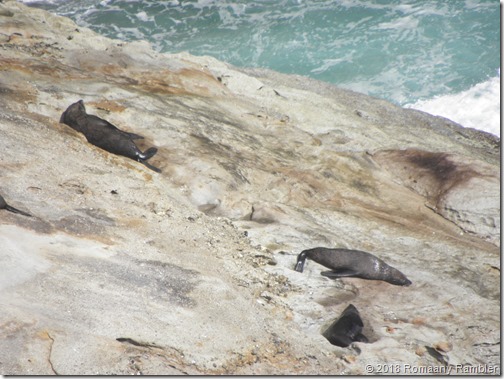
The sea was surging in endless waves and over the rocks.  We looked down to the seals far below.  Some were sunning them selves on the rocks.  And another group were gently bobbing about in the waves, they didn’t seem to be feeding, just enjoying themselves and having fun. 
P2170977

P2170979P2170983
Seals having fun

P1160878
We’re having fun too

Back to the cross road we went, and turned onto the other unsealed road, which took us to the Farewell Spit Information Centre and Café.  We ordered a coffee and date scone and sat on the balcony looking over the spit.  There were large black birds bobbing about off shore, and surprisingly, they turned out to be black swans.  We were surprised to find them in the sea, thinking they were fresh water birds, but according to our bird book, it mentioned that they were found in the tidal waters, including those  east of Farewell Spit.

P1160886

P1160891P2170987

Farewell Spit has been a bird sanctuary since the 1930s and provides a home for over 90 bird species. Bar tailed godwits, knots, curlews, whimbrels and turnstones fly around 12,000 kilometres every northern hemisphere autumn to spend the summer here in the south. The spit also has a gannet colony.  To guide passing ships, Farewell Spit's first lighthouse was built in 1869. In the early years the lighthouse site had no vegetation and windblown sand was an ongoing problem for the keepers. Then one clever keeper organised for small loads of soil to be delivered with the mail. He planted a windbreak of macrocarpa pines which are still there to this day. The pines protect the station from the shifting sands and provide a daylight landmark for passing ships.

P2170985P2170990
Views of the sandy spit from the café balcony

We are so pleased that we have driven to the end of the road north on the South Island.  Rutted and rough it may have been, but the 4WD coped well.  With our sightseeing trip over for the day, we drove back to the camp for some late afternoon R&R – and we were no longer alone, several vans had arrived while we were out.

Friday, 16 February 2018

Another Busy Day

It’s all go on holiday, with one thing after another,  trying to see as much as we can in the time we have left.  The morning started off with a bit of excitement, which had all the campers gazing over at the wharf.  A huge barge had been gently maneuvered into place by a tug.  The boulders from Golden Bay are  being sent across Cook Strait.    Barge-loads of boulders arriving at Wellington's Aotea Quay are part of a massive environmental engineering project to divert streams on the $1 billion Transmission Gully motorway north of the capital.  Rock from earthquake-prone Wellington is not considered up to the task, so the boulders have been shipped in from a quarry in Golden Bay in loads of 3000 tonnes a trip. Their bulk and angular shape meant they held fast in floods to prevent erosion, while working in tandem to create new habitats for wildlife and stream flora and fauna, according to project environmental and stakeholder manager Darren Utting.

P1160626

P2150964

The Port Tarakohe NZMCA Park is quite small, so members really need to get there quite early to find a level site.  There is plenty of entertainment happening on the water with boats coming and going.  And as a bonus, the Boat Club next door has facilities available for the campers, toilets, showers $2, and a washing machine and drier $4.  We never did find out what the large concrete silos above the port were used for – but suspect they were used for cement in the past.

P1160318

We went out and about in the car yesterday, driving through the very busy little town of Takaka, practically overrun with tourists and walkers, all wanting to walk the tracks in the Abel Tasman National Park.  The main street is hung with pretty flowering baskets, and full of cafes to cater for all the visitors.  We saw a rather nice stone church in the main street, and an interesting old hotel.

P1160327P1160331
Sacred Heart Church and the Telegraph Hotel in Takaka

After stopping for a nice lunch at the Mussel Inn, we then stopped on the way back at the Golden Bay Lookout.   There is the sea in the distance, almost hidden by the rolling hills.

P1160685
View from Golden Bay Lookout

A side road leading to Paton’s Rock looked interesting.  We ended up in a little seaside village, and parked by the beach.  It was a pretty view, but where was Paton’s Rock?  So we drove a little further and had another look.  No sign of a big rock, but perhaps that jagged line of rocks reaching out to sea is called Paton’s Rock?  We're not too sure, and Mr Google was no help, in this case.

P1160705
Is this Paton’s Rock?

It was a much better deal at our next stop – there was no mistaking we were at the right place when we called into the car park at Labyrinth Rocks.  Wow – they were certainly something.  The Labyrinth is a world class example of karst limestone topography, we read.

P1160717

P1160755

This unique 2 hectare outcrop of karst limestone was discovered by Dave Whittaker in 1994, a geologist and mining engineer.  He leased the land from the council and cleared weeds, creating tracks within the rocky outcrops.  After years of hard work Dave opened his Labyrinth Rocks Park, but sadly passed away in 2009.  His vision lives on thanks to “Friends of the Labyrinth Rocks” and the Tasman District Council.

P1160758
Plan showing the walkways

We walked along narrow passages, ducking under trees, with towering rocks all around us.  About 25 million years ago the land was lifted out of the sea, and the tremendous forces taking place caused a series of cracks through the rocks, allowing rainwater to enter.  After millions of years the small cracks have widened to become the canyons in the labyrinth.

P1160737

P1160749P1160727
Tunnels, cracks and weird shapes

P2150971
Can you see the Indian Face?

It certainly was an amazing place, interesting, and just a little spooky.  To be  honest, we didn’t explore all the many pathways – there would be enough there to keep you busy for days.  Well worth a visit, and it is free.

Us at Labyrinth Rocks
The necessary selfie, by the rocks

Thursday, 15 February 2018

The Great Kiwi Pub Crawl – Pub no 6

Today we visited the most northern pub in the South Island, as featured in our book, “The Great Kiwi Pub Crawl”.   The sign, attached to an old tree truck, showed us the way to the carpark.

P1160676

Mussel Inn at Onekaka, Golden Bay, is not an old pub, by any means, and was built in 1992.    But it has an older, almost hippy feel to it.  Perhaps it is the fact that this timber built pub has a large verandah.  Timber plays a big part in this pub, as all the table tops, large and small,  have been created from a single tree.  Surrounded by native bush, and shaded by colorful sails, the outside seating area was very inviting indeed on a hot sunny day.  And would be rather nice on sultry evenings when the musicians come to perform, I would imagine.

P1160663P1160667

Inside was more timber and rustic decorations.  The pub was built by Andrew and Jane Dixon, who after building wooden cabins for sale, decided to have a career change and build their own pub.  It is said than on the opening day back in 1992, there was a queue of locals waiting at the door, and business is still booming.  There are a row of hooks above the bar for the local’s beer mugs.  Apparently, this number is finite, and the only way for a new comer to get his own beer mug hanging is to be left one in a will from a friend or family member!

P1160651

P1160655

We were there for lunch, and a steady stream of customers had the same idea.  Robin chose a beef and black beer pie, and I tried the mussel chowder (with garlic bread).  Yes, I know I’ve confessed that I’m not really a fan of mussels, but dining at a place with a name like the Mussel Inn, I decided to try the chowder – very tasty as it turned out.  The pub brews it’s own beer, cider, lemonade and ginger beer.  Robin ordered a Pale Whale, and I had a glass of lemonade.  Finishing up with coffee and carrot cake, so yummy.

P1160673
Beef and black beer pie, and mussel chowder

The bathrooms are different too, with composting toilets and the inside walls covered with colourful posters, and on one side, rows and rows of their own beer stickers.  I didn’t think you really needed to see the toilet, but the walls are worth admiring.

P1160678
Inside the loo

It seems the owners have a bit of a thing about cell phones.  Perhaps they don’t like the sort of customers who talk loudly on their phones when they should be having a quiet beer with their friends.  There is a big pole festooned with cell phones – perhaps warning those who can’t live without them that they could be snatched away and dealt with? 

P1160660
.
P1160669
And for those repeat offenders, there are some more cell phones nailed above the door

Owner Jane Dixon came to chat with us, and kindly wrote a message in our book.  This was a lovely, warm, friendly pub, with great food, and we are so pleased we called.

Wednesday, 14 February 2018

Totaranui and back

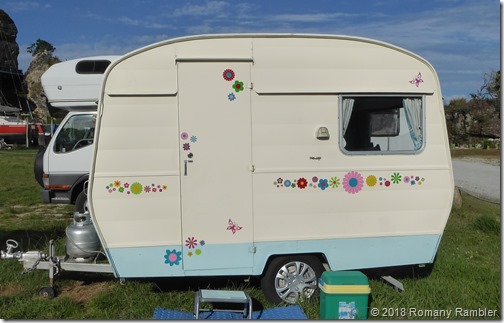
Here at Pohara we are parked beside a dinky little van named Dora, loving painted and decorated with flowers by her owner.  We had 4zees with a group of campers including Dora’s owner yesterday, but sadly her name escapes us.  But we remember that she is from the Wairarapa, lives in a lifestyle village rather like our own, and we have friends in common!

P1160400
Pretty little Dora

Today was a great day to do some more sight-seeing, not quite as hot and sticky as the previous day.  We had decided to visit Totaranui, because we had never been there before.  Our trip started with driving through a hole hacked out of the rock right here in Pohara, and then we were on our way.

P1160403

We reached the end of the sealed road and turned onto a 10km wiggly unsealed road to take us down to Totaranui on the coast. 

P1160425

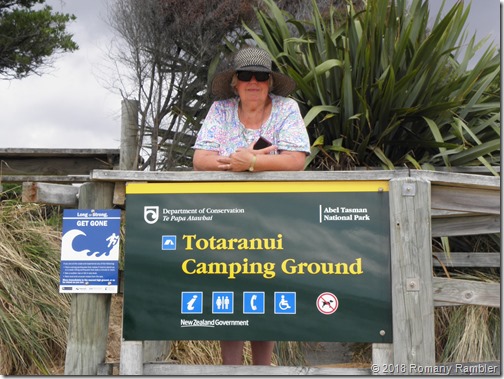
There is a huge DOC campground at Totaranui, which is on the edge of the mighty Abel Tasman National Park.   The place was teeming with walkers, all keen to walk the tracks throughout the park.  Outside the DOC office we saw a group of them all getting instructions.

P1160433P1160436

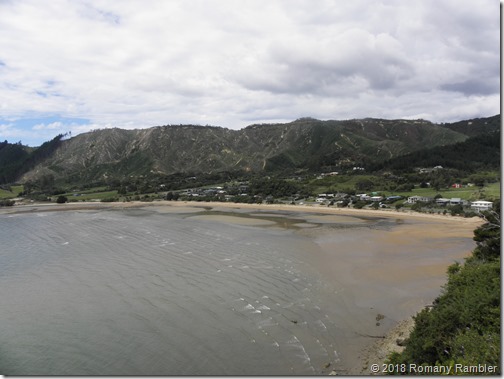
Crowds of campers were milling about down on the beach, ready to board the water taxis and get on their way. Most of them looked young and fit, but there was a sprinkling of older trampers there too.

P1160457

P2140948

P2140947P1160462
Views of the beach

Inside the DOC office, we read about Perrine Moncrieff, the founder of the Abel Tasman National Park.  She wanted to save this pristine area from the loggers, and the MP for Nelson presented the case to Parliament.  1942 was the anniversary of Abel Tasman visit to New Zealand, the park was named in his honour and the Queen of the Netherlands was asked to be patron.  And this marvelous piece of the country was saved for everyone to enjoy.

Back in the car we went, up the hill, and took the other unpaved road down to Awaroa Bay.  This was a bit hair-raising when a huge truck sped towards us on the narrow road.  We backed over to the side of the road as the truck drove past, with inches to spare.

P1160489P1160490

Awaroa Bay has two claims to fame.  The beautiful private beach in the Abel Tasman Park was put up for sale, “Best beach on the planet on the market for two million dollars”, said the headline.  Adam Gardner and Duane Major, a couple of good Kiwi blokes, weren’t going to stand by and let that happen, so they set up a Give-a-little page.  The public got behind them, as did other big players, and the money was raised to purchase the beach.  We couldn’t walk on the very special white sand beach as it was across the estuary, but zoomed in for a photo.

P2140953
Our special beach, now owned by all

The bay is also home to the endangered pateke (brown teal) and young captive bred juvenile birds have been released here in the hope that they will thrive and mate.  These birds are being closely monitored as there are only about 2000 birds left in the wild.

P1160504P1160511

We continued our slow drive back over the hill, and stopped at Tata Beach while we ate our picnic lunch in the sun.  The beach was busy, with swimmers and kayakers, others sunbathing, or walking along the sand.

P1160534
Tata Beach

There was a memorial mosaic bench on the beach, made in the memory of a young woman who had passed away, by four friends.  It really was a work of art and incorporated commercial tiles, together with mosaics made from pottery, glass and beads.

P1160529P1160530
In memory of Kelly

P1160536
Yurts as holiday homes

Lastly, we stopped off at Liger Bay (Named by Abel Tasman as Murderers Bay) to view the Abel Tasman Monument.  We were entertained by the antics of a cheeky weka as we walked up the path.

P2140960P2140957
The flightless weka

P1160605

P2140962
View over Liger Bay

Then it was just a short drive back to Pohara, back through the hole in the rock –maybe it looks different from this side.   It was great to see parts of the country we hadn’t traveled to before.

P1160615
Coming back through

P1160620
Another beautiful sunset