Success is getting what you want; happiness is liking what you get

Tuesday, 13 February 2018

Pohara and Pupu Springs

Driving out of sunny Nelson we left the vineyards behind us, with apple orchards and hops growing up on wires taking over.  Hops, of course, are a necessary ingredient in beer brewing.

P1160271P1160268
Hops growing and a supply of apple boxes

The climb towing the van up the steep Takaka Hill (800m high) was slow and a little nerve-wracking, when we met a large truck coming around a tight corner straight towards us.  Some of those corners were real hair pins but the driver (if not the navigator) kept his cool, and kept on keeping on.  The views, as to be expected, were magnificent.

P1160299

P1160310P1160277
Driving over the Takaka Hill

We’re staying at a “new to us” site, the Port Tarakohe NZMCA Park, in Pohara.  Pohara is a pretty little village, with several interesting looking cafes, I noticed, as we drove by.  Guess we will come and check them out a little later.  The last bit of the road to the port took us under a large overhanging piece of rock, that was a bit of a worry.

P1160387
.
P1160315
Port Tarakohe is a smallish camp, and we parked up with a sea view behind us

After lunch, we decided to go and check out Pupu Springs.  Te Waikoropupū Springs are the largest freshwater springs in New Zealand, the largest cold water springs in the Southern Hemisphere and contain some of the clearest water ever measured.  There is an impressive entranceway, and information panels to read.

P1160337

The track to the springs took us through native forest, along an easy path and boardwalk.  The bush ringed pool is absolutely beautiful, full of the clearest of water bubbling up to the surface.

P1160349

P1160351
Pupu Springs

It is an amazing place, calm and surreal.  At least it should have been – except one selfish tourist had his noisy drone buzzing around the whole time we were there, which rather spoiled the ambience.  We got chatting to a young German girl who just happened to work on a farm in Rongatea, not too far from where we live, what a small world.  She kindly took our photo for us, and we returned the favour for her and her Mum.

P1160356

A little further around the boardwalk was the Dancing Sands Spring, where the bubbling water moves the white sandy bottom of the pool around, making the sand look like it is dancing.

P1160359P1160361
Dancing Sands Spring

P1160363
One last glimpse, as we walked back to the car park

Tourists started visiting the springs in the early days of European settlement.  A viewing platform was built in the early 1900s.  The present day boardwalk is very successful, keeping people away from the sacred water, but still allowing good views of the springs.  Back at the interpretation panels, I came across a huge boulder of pale  greenstone, which everyone loves to touch as they walk by. 

P1160375
Greenstone boulder

Returning to camp we joined some friendly neighbours for 4zees and chatted about all the usual things campers do – where we had all been, where we were all going, and what we had seen.  It had been a great day, and there is sure to be more exploring to do tomorrow.

P1160393
The sun is going down at Port Tarakohe

Monday, 12 February 2018

Three days in Nelson

After saying goodbye to our friendly neighbours camping with us behind the historic Trout Hotel in Canvastown on Saturday morning, we got on our way.  Nelson was our next stop, a drive of 81km.  And we wanted to get there relatively early, as we had heard that the Richmond Motorhome and Caravan Park CAP (charges apply parking) had been full up lately, and we didn’t want to miss out on a site.  We passed by the pretty DOC Camp at Pelorous Bridge, drove through the Rai Valley, then tackled the Richmond Range.  This was rather steep in places, so it was a slow trip up and over the range.   Once we saw the Welcome to Nelson sign, we knew we were almost there.

P1160180

Of course, there was room for us at the Richmond Motorhome and Caravan Park, so we didn’t have to think about Plan B.  We had stayed here previously, and it is a good park with power, water, rubbish disposal, toilets and laundry available, at a very reasonable $15 a night on power.  Here we are parked up between two other Leisureline vans – our stay was to be for three nights.

P1160192
Three Leisurelines in a row

P1160212
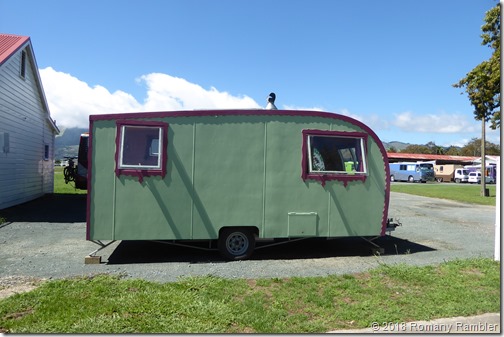
Not sure what this vintage van is, it could well be home-made

There has been a new addition since our last visit – a chain from the Wahine Ferry which capsized in Wellington Harbour in April 1968 with the loss of 53 lives, had been placed in front of one of the gardens on the adjacent race-course.  The white writing on the chain links relates the story of the tragedy.

“Wahine anchor chain
Wahine built (in) Scotland 1965-66
Lyttleton – Wellington roll-on, roll-of ferry
Wahine foundered in severe storm 10th April 1968
With 123 crew and 612 passengers
At entrance to Wellington Harbour, 53 perished”

Read more about the Wahine Disaster here

P1160181
Wahine anchor chain

Then on Sunday the heavens opened up and the rain came down in sheets.  After weeks of dealing with hot temperatures in the 30s and hiding from the sun (not that we were really complaining about the hot weather) it was now wet, wet, wet.  Large puddles formed outside, and the heavy rain was keeping all the campers inside their vans.  Except for the neighbour on the right of us, we watched him out in the pouring rain, wearing his togs (swimming trunks) as he vigorously wiped down his van.  It didn’t seem right to take a photo of him,  but it did look so  funny.

P1160202
And the rain came down

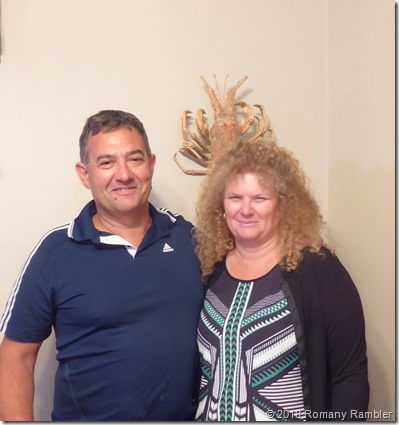
It may have been a wet, miserable day, but we had been invited to join the rellies in a Sunday roast dinner.  Robin’s sister Kaye and hubby Jan live in Richmond and kindly took pity on a couple of campers – and to be honest, we don’t cook roasts while we are traveling around.  It was so nice to catch up with all their family news,  and the roast lamb meal was divine!  Can you see that crayfish shell on the wall?  Jan and his mates are keen fishermen, and often bring home crayfish and blue cod to feed family and friends.

P1160209
Jan and Kaye

By Monday morning the rain had long gone, and it promised to be a scorcher.  With a load of washing done and hanging out in the sunshine to dry, we decided to do some sight seeing.  Just up the road is the remains of a huge Tasmanian Blue Gum tree, known as the Otterson Gum.  Following a branch falling down, it was discovered that there were major structural problems and this notable tree was felled in 2005 at the age of 158 years.

P1160219
All that remains of the Otterson Gum

Then it was on to Mapua Wharf to enjoy eating fish and chips from The Smokehouse, seated outside in the sunshine – a “must do” Mapua experience.  This was followed by an ice-cream for him and a coffee for her.

P1160225

P1160227P1160233
Lunching at Mapua Wharf

Once a busy coastal freight wharf during the orchard heyday, Mapua Wharf is now a trendy restaurant, bar, café and arts and crafts precinct.   But the remnants of it’s early history still remain in the buildings. 

P1160223
The former Mapua Cool Stores

After all the heavy rain which fell the previous day the water was a very dirty, muddy colour.  It wasn’t usually like that, we were told by a couple of locals.  It was great to be out in the sun shine after all the rain on Sunday, enjoying exploring the wharf.  And by the number of people wandering around, it seemed that a very popular destination.

P1160241
View from Mapua Wharf

Friday, 9 February 2018

Havelock and the Pelorus Mail Boat Cruise

Another item ticked off the Bucket List – the Pelorus Mail Boat Cruise.  And what a day we had.  With an early morning wake-up call courtesy of the alarm clock, we drove  back around the coast from Canvastown to Havelock, arriving bright and early at Pier 2, found a car park, paid our $6 for the privilege, and checked in at the office.

P1150913

P1150947
Waiting to board

With different trips every day of the week, our trip on Friday was to travel the “Outer Route”, seeing the sights and dropping off mail bags as we went.

P1150953

P1150961

The Marlborough Sounds is a system of drowned river valleys, which were formed after the last ice age around 10,000 years ago. Pelorus Sound has a main channel which winds south from Cook Strait for about 55 km, between steeply sloped wooded hills, until it reached its head close to Havelock town, as well as several major arms.  Our trip took us in and out of these tranquil waterways, surrounded by endless tree covered hills.

P1150978P1160083

Delivering the mail meant chugging slowly into the bays, nudging up to the jetty, leaning precariously out, and swapping mail bags with the customer.  Bindy did all this with aplomb, as well as chatting happily to the customers as she leant over the boat rail.

P1160008

Sometimes the customers brought their pets along to meet the mail boat, so we got to meet them too.  This is Paul the pig, who was practically climbing into the skipper’s window, drooling and grunting,  while Bindy fed him biscuits.   Then at another stop, we admired two rather cute Kune Kune pigs who came to meet everyone on the boat.

P1160035P2090929

Most of us went on a farm tour at Wilson’s Bay, with the 5th generation still farming today.  The boat dropped us off, then delivered the other passengers who had booked into a restaurant for lunch at a nearby bay.

P1160090 

We wondered what was hanging on the fence.  It  was a collection of jaws from feral pigs shot on the property, these wild pigs do a lot of damage killing and eating young lambs.  The young farmer then gave a shearing demonstration.  Lots of cameras were clicking wildly as this was happening.  It looks so easy when you know how, but it really is back breaking work.

P1160108 

P1160117P1160125

Back on the boat again, the skipper eased up to a flock of Fluttering Shearwater birds, as they were feeding in the sounds.  Fluttering shearwaters eat small fish, which are caught by pursuit diving, using partially-folded wings for propulsion.

P2090898P2090897
Fluttering Shearwaters

Another interesting bird spotted was the King Shags with their pink feet, living on a tiny island almost at the open sea, and they are only found in the Marlborough Sounds.  King shags are deep divers, feeding on bottom-dwelling fish species, and have been recorded foraging in water depths down to 50 m.

P2090918
King Shags

And take a look at this nasty looking thing.  It was a Lion’s Mane Jellyfish, quite  pink, with a whole lot of stinging tentacles floating underneath.

P2090910
Lion’s Mane Jellyfish

The skipper took us to see how the Mussel Boats go about harvesting the mussels, as they pull up the long ropes which have growing musses attached.  Mussel farming is very big business in the Marlborough Sounds.

P2090943

Then it was time to head back to port – it had been a great trip and a very interesting day indeed.

P1150977

We finished our day out with a quick look around Havelock, named after Sir Henry Havelock, before driving back to our van parked up at Canvastown.  Havelock  is known as the Greenshell  Mussel Capital of New Zealand.   Green lipped mussels are grown and harvested here, and the small town certainly celebrates them.  Havelock's origins lie with the Wakamarina Gold Rush of 1864 when Havelock grew from a staging post between Blenheim and Nelson to a town with a main street boasting 23 hotels.

P1150937

For those wanting to try this delicacy, the Mussel Pot seems to be the place to dine.  You can’t miss this restaurant, it has a big pot of mussels on the roof, plus loads of others dancing on the edge of the roof on their little skinny legs.  Not for us, though, we don’t really care for mussels – give us oysters or scallops any day.

P1150931
Havelock icon – Mussel Pot Restaurant

Thursday, 8 February 2018

On to Canvastown

There was a tap at the caravan door while I was doing a bit of tidying up, prior to moving on from the Waterlea Racecourse in Blenheim.  A couple of smiling faces asked, “Remember us?”  Of course we recognised them, it was Pam and Bob, although we hadn’t met up for several years.  Those with long memories might remember that Robin and Bob, together with a couple of others,  produced the CCNZ magazine “Out and About” for a number of years.  It was so nice to meet up with them again, and catch up with al the news.

P1150874
Pam and Bob

After lunch, we hooked up and went on our way.  Not too long, just 51k to our next stop, the Trout Hotel, at Canvastown.  Originally named Wakamarina, but local usage quickly renamed it Canvastown after the influx of miners and their many canvas and calico tents which sprang up with the gold rush of the 1860s.

P1150943

We are parked up behind the Trout Hotel, with two other vans to keep us company, at a very reasonable $15 per night for a powered site.  We have stayed here before, and it is a nice peaceful setting.

P1150888

P1150910
Trout Hotel

The bar is decorated with stags heads, and a huge assortment of mugs hanging from the rafters.  There must be a story behind them, I feel.  We plan to have a meal in the pub tomorrow night – perhaps I can ask the publican about them.

P1150892
In the bar