Success is getting what you want; happiness is liking what you get

Wednesday, 7 February 2018

Blenheim and Omaka

We are currently staying at Blenheim, a small town in the Marlborough area.  The town was  named after the Battle of Blenheim (1704), where troops led by John Churchill, 1st Duke of Marlborough defeated a combined French and Bavarian force.  Blenheim is the focal point for the Marlborough wine growing region, and well known for producing Sauvignon Blanc. It is New Zealand’s largest winemaking region with around 65 wineries and 290 grape growers and over 4000 hectares planted in grapes, mainly Sauvignon Blanc, Chardonnay, Riesling, Pinot Noir, Pinot Gris and Gewurztraminer.

P1150823
Just one of the many local vineyards

We are camping at the Waterlea Racecourse together with 30 or so vans and campers, this is a very popular stop-over.  There is nice grass to camp on, toilets, water and a dump station on site, together with a laundry. Now and again we see the horses put through their paces, which is always interesting.

P1150622P1150629

P1150623
Camping at the race course

Today we went to the Omaka Aviation Heritage Centre to see the exhibition “Dangerous Skies” about WW11.  Just like magic,  a tiny little vintage bi-plane taxied in to the Aero club next door as we were getting out of the car, obviously someone had just returned from a joy ride.  With the wind whistling through the open cockpit, it must have been a thrilling ride indeed.

P1150638

Like World War One’s Knights of the Sky, Dangerous Skies features mannequins by Weta Workshop and original, flyable static aircraft in larger than life dioramas capturing specific snapshots in history.  This new exhibition had only been up and running for a year, so we were very pleased to be here to see it.

P1150647P1150654

There was quite a range of war posters displayed on the wall as we entered.

P1150664

P2070864P2070865

Then into the exhibition – dim lighting with the sounds of planes overhead.  It was a great atmosphere. The exhibition told the tales of real fighting men, such as James Hayter from Timaru, known to his friends as Spud.  He escaped his burning Hurricane above Kent during the Battle of Britain, landing on the grounds of Great Swifts Estate.  On convincing the grounds man who challenged him with a hay fork that he was with the RAF and not one of the enemy, James was welcomed to the cocktail party taking place at the manor.His minor head wound was dressed by a lady doctor, one of the guests, but surprisingly she later sent him an account for her services.

P1150666
James Hayter gate crashing the cocktail party.

The huge MK.1. Avro Anson (named after British Admiral George Anson) seemed to dominate this part of the exhibition.  By the outbreak of the Second World War, the Anson was soon found to have become obsolete in front line combat roles. However, large numbers of the type were put to use as a multi-engined aircrew trainer, having been found to be suitable for the role, and became the mainstay of the British Commonwealth Air Training Plan.

P1150675
MK.1. Avro Anson

The Dispersal Hut was sobering.  Seats outside while resting, ready to scramble once the call was received.   There was  a blackboard showing the pilot’s names, with many of them never to return from their mission.  

P1150686

There were many info boards around the exhibition, and it was interesting to read where the Battle of Britain pilots originated from.  135 came from New Zealand, making the third largest contribution after Great Britain and Poland.

P1150687

The Curtiss P-40 Warhawk is an American single-engined, single-seat, all-metal fighter and ground-attack aircraft that first flew in 1938.  P-40 Warhawk was also known as the Tomahawk and Kittyhawk.

P1150705
Curtiss P-40 Warhawk

The Mk XIV Spitfire could climb to 20,000 ft (6,100 m) in just over five minutes and its top speed.  Wing Commander Peter Brothers, O/C Culmhead Wing in 1944–1945 and a Battle of Britain veteran stated, “It was truly an impressive machine, being able to climb almost vertically – it gave many Luftwaffe pilots the shock of their lives when, having thought they had bounced you from a superior height, they were astonished to find the Mk XIV climbing up to tackle them head-on, throttle wide open!”

P1150770
MK.14 Spitfire

Our visit concluded with the “Stalingrad Experience”, an eight minute audio visual sequence, shown on curved screens.  Stalingrad was in ruins, and planes roared overhead, dropping bombs on the already devastated city.

P2070867
Bombing of Stalingrad

This was a very interesting exhibition, and we can certainly recommend it  - senior discounts are available, as well as a cafĂ© for a pick-me-up coffee and snack afterwards.

Tuesday, 6 February 2018

A Road less Traveled

The 2016 Kaikoura earthquake caused significant damage to the area, closing both State Highway 1 (SH1) and the Main North Rail Line between Picton and Christchurch. The damage caused by the 7.8-magnitude November 2016 Kaikoura earthquake to the Main North Line railway and SH1 along the east coast of the South Island was unprecedented in New Zealand. With close to a million cubic metres of rock and material falling onto the coastal transport corridor, Kaikoura and the surrounding rural communities became isolated - all roads and the rail network in and out of the area were damaged and closed by multiple slips.

A year after the earthquake the road is finally open once again, and we towed the van behind us on our way north today.  What would we find, we wondered?  It was a rainy, wet miserable day when we set out from Kaikoura.

P1150477
A wet day to travel

Although this part of SH1 is now open, and the contractors have been working day and night for the last 12 months, it was obvious that the work is far from completed.  As it was a public holiday, Waitangi Day, not many of the contractors were working, but the Stop/Go people were on duty when the road became single laned.  We passed by plenty of big machinery.

P1150483P1150506

The slip faces have mostly been cleared of loose material, and barriers have been put in place to protect workers and motorists from further landsides.  Containers are lined up in a row in places, and concrete blocks line the road further along.

P1150571P1150542

The multiple slips were massive, and it was impossible to photograph their true size as we drove past.  And we reflected on the mighty power which tore these hills apart, depositing huge areas of rock and dirt all over the highway.  It was a miracle that no cars were found buried under all this debris.

P1150549
Driving by yet another land slip

P1150588
The hills in the distance show signs of more slips

The road left the coast and took us slightly inland, and we stopped briefly at Ward – where we checked out the local weather forecast.  The weather station confirmed that it was “still raining”.

P1150602
Yes, it’s still raining

By the time we arrived at Blenheim the rain had stopped and it was warming up nicely.  The Waterlea Racecourse will be our place to stay for  the next two nights.

Monday, 5 February 2018

Out and about in Kaikoura

The NZMCA park in Kaikoura is just across the road from the beach.  What could be better than a gentle evening stroll along the beach as the sun goes down?  Plenty of people agreed with us, as there were crowds  taking in the atmosphere last night.  It was a lovely finale to our first night here.

P1150383
Kaikoura beach in the evening

Last year Kaikoura suffered a huge earthquake which did immense damage to the road and rail link, leaving this town cut off from some time.  The coastline was raised dramatically, and our stay here gave us the chance to see some of the changes.  South Bay now has a raised coastline, with rocks now lifted up, which were previously covered by sea water.

P1150341
South Bay

Kaikoura is a peninsular so there was plenty of coastline to view, and we drove around to the New Wharf.  Built in 1909, the new wharf is not so new any more, and was full of families (and a couple of patient dogs) enjoying a day out fishing.  With such warm weather,  it certainly was a great day for fishing.

P1150411
Fishing off the New Wharf

There was plenty of uplifted rocks from the earthquake to see around this part of the peninsular too.

P1150415
More uplifted rocks on Kaikoura’s coastline

We called in to visit Fyffe House, an historic property administered by Heritage New Zealand.  As members of this association we qualified for free entry.

P1150418
  Fyffe House

This historic house is built on the “bones of whales” and is all that remains of Waiopuka Whaling Station.  It really is built on top of whale bones, and we were shown where vertebrae bones were laid as a foundation to support the house.

P1150423
Whalebone vertebrae peeping through , and a full sized bone on the step

European settlement of Kaikoura began in 1842 when Scotsman Robert Fyfe established a whaling station. His cousin George Fyffe (they spelt their surnames differently) joined Robert later. Harpooned whales, mostly Southern Right Whales, were dragged to a large rock shelf in the bay near Fyffe House and their flesh removed and boiled down for oil. Southern Right Whales were already rare in the 1840s and their numbers soon collapsed. At this time George Fyffe and many of the whalers turned to sheep and dairy farming to make a living.

P1150426P1150429

We spent a little time looking through the downstairs part of the house, then climbed the terribly narrow staircase – people obviously had much more dainty feet in those days.

P1150446

P2050855P2050856
Inside Fyffe House

Fyffe House was occupied by only three families over the years, the Fyffe’s 1842-1868, the Goodall’s 1868-1920,  and the Lows 1920-1980.  The last remaining Low family member donated the house to Heritage New Zealand in his will.

P1150452
Whale bones at Fyffe House

Then we drove up to the lookout to see the sights, which took in both sides of the peninsular and the surrounding mountain range.

P2050862

P1150462

P1150461
Views from the top

P1150473
  A friendly German tourist took our photo for us.

Kaikoura is now back to it’s bustling best, chock full of tourists, which is really the life blood of the town.  The Whale Watch and other industries are up and running again, after a long slow year with visitors unable to get through to Kaikoura due to the huge damage on SH1 after the big earthquake. 

Sunday, 4 February 2018

Parnassus to Kaikoura

On Friday afternoon we four were enjoying 4zees in our van when a car drove into the back paddock where were were camped.  Wonder who it was, perhaps the owner coming to collect the camping fees?  Nope – it was none other than caravan friends Noel and Lynn,  and we didn’t even know they were having their own version of a South Island holiday.  It was so nice of them to take the time to track us down and pop in for a visit, and there was a lot of talking going on.  With so much chatter – I forgot to take photos!

It was time to move on today, and both Robin and Bill were busy winding up the steadies, hooking up the cars, and we were both ready to continue on our respective journeys.  Bill and Val were heading south to Peel Forest, while we were continuing north.  It was so nice to meet up for the last three days, and spend a little time in their company.

P1150197
Bill and Val – heading south

We traveled up SH1, with a lunch stop at Cheviot.  As the weather was wet and miserable, we decided a hot pie was in order, and stopped at the Magpies Rest for a lamb pie and coffee.  Plus a large jar of honey for Robin, produced locally at nearby Gore Bay.  Robin loves his honey, and this large jar should keep him going for quite some time.

P1150203

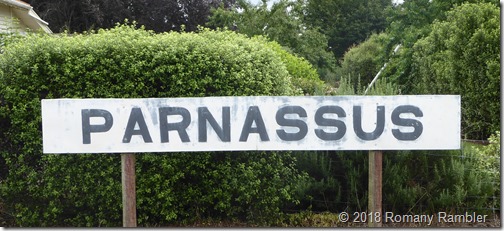
Then it was just a short trip further up the road to the Parnassus NZMCA Park.  It takes its name from a local sheep run owned by a classical scholar, Edward Lee. He saw a likeness between a local hill and the Greek Mount Parnassus, mythical home of the god Apollo and the Muses.

P1150209

The site was a former school and there is a large grassed area, or hard standing to park on,  with the perimeter planted with many trees.  There is a meeting room with the usual shelves full a swap-a-book, and less usual at NZMCA parks, two toilets are available.  The park is almost like an island, cocooned between the busy SH1 on one side, and vast areas of farm land on the other. There were about 25 vans staying overnight.

P1150206

P1150218
At Parnassus

It was to be a one night stop only, then my goodness, did the temperatures drop down low overnight.  Then we were on our way to Kaikoura.  The trip over the Hundalee Hills was windy and slow and eventually we made it to the coast.  The damage done to the road and adjacent cliffs by the 2016 Kaikoura earthquake was certainly evident.   The magnitude 7.8 earthquake occurred two minutes after midnight on 14 November 2016.  Ruptures occurred on multiple fault lines and the earthquake has been described as the "most complex earthquake ever studied”.  Work is still being carried out  around the clock.

 P1150308
Scaffolding for safety and containers to keep and rock slides from the road

We drove past abseilers dangling from a rope on a cliff face, and they can work 10 hour  shifts hanging from their ropes.  The work involves drilling and fixing giant anchor bars metres into the rock, then pinning geomesh over the cliff face to stop rocks falling on the highway below. There were 10 big abseiling sites along the stretch of earthquake-affected highway, with approximately 79 abseilers from six companies carrying out road protection measures across the various sites.

P1150320
Abselier at work

We arrived at the Kaikoura Trotting Club NZMCA Park, arriving at 1.00pm, in time for lunch.  During the day more and more vans rolled in, and we were a packed in like sardines in a tin.  The empty space beside us soon filled up with several vans tucked into the corner.

P1150354
We are lucky we arrived early

P1150360
Not much more room left now

The weather warmed up nicely during the day, causing us to shed a layer or two of clothing.  We will be spending two nights here, which will give us time to do a little exploring tomorrow.

Friday, 2 February 2018

Chatterley Manor and Winston Churchill

While we are camping in the back paddock of Chatterley Manor, and there is nothing wrong with that – the front of the property is quite something and looks very grand indeed.  As well as being a B&B, it is also a wedding venue, with guest accommodation.  We were invited to walk around the gardens, so we did.

P1150125

The rose garden was very pretty, and there are sculptures al through the gardens.  The rustic green cow contrasted nicely with the rather elegant moose.

P1150135P1150166
Animal sculptures

The owner’s three little poodles rushed out barking loudly to see what we were up to as we slowly walked around the garden – and then, warning duty done, happily went back inside again.

P1150154
Chatterley Manor

On our travels around town we followed a truck driver under instruction - we hadn't seen one of these before.  The small truck was well loaded up with concrete blocks.

P1150177

After lamenting the hot sticky weather for the last wee while, things have certainly changed.  Yesterday everything went pear-shaped with a huge storm pounding large parts of the country.  Rain and powerful winds caused flooded homes, roads closed, roofs lifted off homes, many people evacuated, storm surges, and goodness knows what else, it was hard to keep up with all the warnings.  SH6 between Franz Joseph and Fox Glacier was closed due to slips and downed power lines trapping about 115 tourists who spent the night in their cars.  And even more people trapped in Haast as slips closed West Coast highways.  Whew- luckily we weren’t on the West Coast yesterday,  we are still safely tucked up in the back paddock at Chatterley Manor.

The wind had dropped a little in our area this morning but it was still raining and very wet underfoot, and the temperature was down to 14degC.  No sight-seeing today we decided, but we took ourselves off to the movies instead.  We saw “Darkest Hour”, the story of Winston Churchill and his early turbulent time as Prime Minister while German war machine rolls across Europe, with the threat of invasion of the United Kingdom.  It was a very strong portrayal of Churchill,  with the powerful words of his great speeches ringing out which did so much to rally the nation.

P1150191

Senior prices are always welcome when we go to the movies, but that wasn’t the only benefit.  Free morning tea was nicely set out on a table, with freshly brewed coffee and locally baked biscuits available for theatre patrons. 

P1150188 
Free morning tea as well

While we were engrossed in the film the wind seems to have died down and the rain had stopped.  Christchurch seemed to get off with lesser damage than a lot of other areas, but there will be a lot of clean up still to take place in the badly hit areas.